Some technologies change how engineers work. The femtosecond fiber laser is one of them. Think about what happens when a laser pulse lasts just a few quadrillionths of a second. The material it touches has no time to heat up, melt, or crack. The energy goes straight into vaporizing the target zone, cleanly and precisely. That is cold ablation, and it is the defining advantage of ultrafast fiber lasers over every other laser technology that came before them.
Engineers across semiconductors, aerospace, ophthalmology, and biomedical research now rely on these systems for tasks that were once impossible or too expensive to achieve. And because fiber laser platforms are compact, maintenance-free, and thermally stable, they fit into real production environments, not just research labs.
This guide covers everything you need to know: how femtosecond fiber lasers work, what makes them different, where they deliver the most value, and how to choose the right system for your application.
What Is a Femtosecond Fiber Laser?
A femtosecond fiber laser is an ultrafast laser that produces optical pulses with a duration measured in femtoseconds. One femtosecond equals 10⁻¹⁵ seconds, or one quadrillionth of a second. To put that in perspective, a femtosecond relates to a second in the same way a second relates to roughly 31 million years.
These lasers sit within the broader category of ultrashort pulse lasers. The key distinction from nanosecond or picosecond systems is peak power. Even at modest average output levels, a femtosecond pulse concentrates enormous peak power into a tiny time window. That peak power drives nonlinear optical interactions, initiates multiphoton absorption, and removes material through direct vaporization rather than melting.
The fiber laser platform adds further advantages on top of this. Optical fibers guide and confine the beam within a waveguide structure. This produces exceptional beam quality, strong thermal stability, and a compact footprint. It also eliminates the need for free-space alignment and cavity mirrors, which dramatically reduces maintenance requirements compared to bulk solid-state systems.
How Ultrashort Pulses Form: Passive Mode Locking
Passive mode locking is the mechanism that generates femtosecond pulses inside the laser cavity. All lasers support a set of longitudinal resonator modes, each with a slightly different wavelength. In a standard laser, these modes oscillate independently and randomly. The output is continuous or quasi-continuous.
Mode locking forces all these resonator modes to oscillate in phase with each other. When modes align in phase, they interfere constructively at one point in time and destructively everywhere else. The result is a sharp, intense pulse that circulates inside the cavity. Each time the pulse reaches the output coupler, a fraction exits as a usable ultrashort pulse.
Passive mode locking achieves this without any active electronic switching. A saturable absorber inside the cavity attenuates low-intensity light and becomes transparent to high-intensity pulses. This self-reinforcing behavior stabilizes the mode-locked state automatically.
Modern fs fiber lasers typically run at repetition rates between 20 MHz and 200 MHz, meaning tens of millions of pulses exit the cavity every second. Individual pulse durations range from under 50 fs to a few hundred femtoseconds, depending on system design.
Femtosecond Fiber Laser vs Solid-State Laser: Key Differences
Buyers evaluating ultrafast laser platforms commonly ask whether a fiber-based system or a solid-state bulk laser is the better fit. Both deliver femtosecond pulses, but their operational characteristics differ significantly.
Fiber laser advantages:
- No free-space alignment required. The fiber waveguide maintains beam path integrity without manual adjustment.
- Compact form factor. Fiber systems fit into small enclosures and integrate cleanly into production equipment.
- Maintenance-free operation over long duty cycles.
- Better thermal stability. The fiber geometry distributes heat efficiently along its length.
- Lower cost of ownership compared to Ti:sapphire or Nd:YAG bulk systems.
Solid-state laser advantages:
- Higher peak pulse energies per shot, particularly relevant for Ti:sapphire systems at mJ-level outputs.
- Broader wavelength tunability, especially when paired with optical parametric oscillators.
- Better suited for extremely high pulse energies in specialized research settings.
For most industrial and applied scientific applications, the fiber platform wins on practicality. The Solid Laser all-solid-state laser series remains the right choice when single-shot energy requirements exceed what fiber amplifiers can deliver, but for repetitive precision tasks, the fiber platform is consistently preferred.
Core Technical Parameters of a Femtosecond Fiber Laser
Understanding the key specifications helps buyers select the right system and engineers optimize their processes. Here are the parameters that matter most.
Pulse Duration
Pulse duration is measured in femtoseconds (fs). Commercial systems typically deliver pulses between 50 fs and 500 fs. Sub-100 fs systems provide the highest peak power and the clearest cold ablation behavior. For multiphoton microscopy and nonlinear spectroscopy, shorter pulses maximize excitation efficiency.
Repetition Rate
Repetition rate is the number of pulses the laser emits per second, measured in MHz. Higher repetition rates increase average output power and processing throughput. Most fiber femtosecond oscillators run between 20 MHz and 200 MHz. Some systems allow pulse picking to reduce the repetition rate for applications requiring higher per-pulse energies.
Wavelength
The two dominant wavelength bands for femtosecond fiber lasers correspond to the available gain media. Ytterbium-doped fiber lasers operate near 1030 to 1100 nm. The 1064 nm output is particularly common for industrial micromachining. Erbium-doped fiber lasers operate near 1550 to 1600 nm. This band aligns with the telecom C-band and is widely used in spectroscopy, coherence tomography, and THz generation. Solid Laser’s SHSL-UV Series delivers UV wavelengths for applications where shorter wavelengths are required.
Average Power and Peak Power
Average power is what gets measured with a standard power meter. Peak power is what drives the physics. A 1 W average power laser running at 100 MHz with 100 fs pulses delivers approximately 100 kW of peak power per pulse. That ratio, roughly five orders of magnitude between average and peak, explains why femtosecond systems can ablate hard materials that a 1 W continuous laser could not scratch.
Beam Quality (M²)
Beam quality describes how closely the output resembles a perfect Gaussian (TEM00) beam. An M² value of 1.0 is ideal. Fiber lasers routinely achieve M² values below 1.3, making them suitable for tight focusing and precise material processing.
Femtosecond Fiber Laser for Precision Micromachining
Precision micromachining is the largest single application segment for femtosecond fiber lasers. The global ultrafast laser market is driven primarily by this segment, and fiber systems have taken the lead.
Why No Heat-Affected Zone Matters
Conventional laser processing deposits heat into the workpiece. That heat spreads into surrounding material, creating a heat-affected zone (HAZ). The HAZ causes microcracking, recast layers, burrs, and dimensional inaccuracy. For hard or brittle materials like glass, ceramics, and thin semiconductors, even a small HAZ can ruin the part.
Femtosecond pulses are short enough that energy transfer to the lattice occurs after the pulse has ended. The ablation threshold is exceeded and material is removed before thermal diffusion can spread heat to adjacent areas. The result is a clean, sharp edge with no visible HAZ.
This cold processing capability makes ultrafast lasers the preferred tool for:
- Drilling micro-holes in turbine blades and fuel injector nozzles
- Cutting OLED display panels and flexible electronics
- Scribing solar cells and thin-film photovoltaic layers
- Structuring implantable medical device surfaces
- Micro-drilling stents and other cardiovascular components
Femtosecond Laser Glass Cutting
Glass is notoriously difficult to cut with conventional lasers. The HAZ causes cracking along cut lines. Femtosecond laser glass cutting changes this entirely. The ultrashort pulses induce a phenomenon called stealth dicing, where internal modification of the glass bulk creates a controlled cleave line. Yields are higher, edges are cleaner, and no dicing saw is required.
Display manufacturers use this technique for smartphone cover glass, camera lens arrays, and AR/VR optical elements. Semiconductor packaging relies on it for wafer singulation.
Femtosecond Laser Semiconductor Processing
The semiconductor industry demands the tightest tolerances of any manufacturing sector. Femtosecond laser semiconductor processing enables cutting, drilling, and surface modification of silicon, gallium arsenide, and emerging compound semiconductors without contaminating the surrounding die.
Key applications include via drilling for through-silicon vias (TSVs), wafer marking, chip repair, and photomask processing. Repetition rates in the tens of MHz provide the throughput needed for high-volume production alongside the precision needed for sub-micron features.
Scientific Applications: Spectroscopy, Imaging, and Metrology
The scientific community relies on femtosecond fiber lasers as enabling tools across a wide range of disciplines. The combination of high peak power, broad spectral bandwidth, and temporal coherence opens doors that no other light source can.
Ultrafast Laser Spectroscopy
Ultrafast laser spectroscopy uses femtosecond pulses to probe chemical and physical dynamics at the molecular and atomic level. Pump-probe spectroscopy, for example, uses one pulse to initiate a reaction and a second delayed pulse to interrogate the sample state at precise time intervals. Dynamics on timescales from femtoseconds to nanoseconds become directly observable.
Raman spectroscopy benefits from the high peak power of fs pulses, which enhances nonlinear Raman signals and improves signal-to-noise in trace chemical detection. The Solid Laser SHSL Series supports Raman spectroscopy applications where high repetition rate DPSS performance is required alongside a stable, mature platform.
Femtosecond Laser Multiphoton Microscopy
Multiphoton microscopy is one of the most impactful biomedical applications for ultrafast lasers. Two-photon excitation microscopy (2PE) uses the simultaneous absorption of two near-infrared photons to excite fluorophores that would normally require UV light.
Because two-photon excitation only occurs at the intense focus of the laser beam, the technique delivers inherently three-dimensional spatial resolution without the need for confocal pinholes. Tissue penetration depth improves significantly compared to single-photon UV methods. Living tissue can be imaged at depths of several hundred micrometers.
Femtosecond fiber lasers serve as ideal sources for 2PE microscopy because their high repetition rates allow rapid image acquisition and their compact form factors fit within the space constraints of inverted microscopes. Pulse durations below 100 fs at the sample maximize two-photon signal without damaging the specimen.
Frequency Combs and Optical Metrology
Mode-locked femtosecond lasers naturally produce what physicists call an optical frequency comb. The comb consists of thousands of evenly spaced narrow spectral lines extending across a broad wavelength range. The spacing between lines equals the laser repetition rate, which is stabilized with extreme precision.
Optical frequency combs connect optical frequencies directly to microwave frequency standards, enabling absolute frequency measurements with 18-digit precision. This made atomic optical clocks possible and earned researchers the 2005 Nobel Prize in Physics.
Beyond atomic clocks, frequency combs enable lidar-based precision ranging, molecular fingerprinting for trace gas detection, and calibration of astronomical spectrographs searching for exoplanets.
Femtosecond Laser THz Generation
Erbium-doped femtosecond fiber lasers at 1550 nm serve as efficient pump sources for terahertz (THz) generation. When the output illuminates a photoconductive antenna or nonlinear crystal, it generates broadband THz radiation.
THz time-domain spectroscopy probes molecular vibrations, characterizes dielectric materials, and identifies explosives and drugs through packaging. The femtosecond excitation pulse defines both the bandwidth and time-domain structure of the THz output, making fs fiber lasers central to all commercial THz spectroscopy instruments.
Medical and Biomedical Applications
Medical applications represent the single largest end-use segment by revenue in the femtosecond fiber laser market, driven by the precision and minimal thermal damage these systems provide.
Femtosecond Laser Ophthalmic Surgery
LASIK and related refractive eye surgery procedures now commonly use femtosecond lasers to create corneal flaps and perform intrastromal cuts. The ultrashort pulses cut tissue with sub-micron positional accuracy and no collateral thermal damage to surrounding corneal tissue.
Modern fs ophthalmic systems can achieve a 2–5 micrometer axial resolution during corneal procedures. Patient outcomes have improved substantially compared to older microkeratome blade techniques. Recovery time is shorter and complication rates are lower.
Two-Photon Polymerization for 3D Nanofabrication
Two-photon polymerization (2PP) is a nanofabrication technique that uses focused femtosecond pulses to harden photosensitive resin at a single voxel (volume pixel) in 3D space. Feature sizes well below the diffraction limit are achievable, with resolution down to 100 nm in commercial systems.
Researchers use 2PP to fabricate microfluidic devices, optical waveguides, scaffolds for tissue engineering, and micro-optics for photonic integration. The technique requires a stable, high-repetition femtosecond source with good beam quality, specifications that compact fiber laser systems satisfy.
Femtosecond Fiber Laser vs Picosecond Laser: Which Should You Choose?
This comparison comes up constantly for buyers in industrial applications. Both technologies offer ultrashort pulses. The right choice depends on the application.
Femtosecond lasers deliver the shortest pulse durations, the highest peak powers for a given average power, and the cleanest cold ablation behavior. They are the best choice when material quality is paramount, especially for transparent or brittle materials.
Picosecond lasers offer higher pulse energies from amplified systems and often better average power scalability. For some metals and polymers, picosecond pulses provide sufficient quality with faster processing throughput.
For glass, sapphire, silicon, and delicate biological specimens, the fs laser is consistently superior. For high-throughput metal ablation where some HAZ is acceptable, picosecond systems may provide better economics.
The Solid Laser SMSL Series covers compact solid-state configurations for applications where pulse energy matters more than the absolute shortest pulse duration.
Ytterbium vs Erbium Femtosecond Fiber Lasers: Choosing the Right Wavelength
Wavelength selection is one of the first decisions in any system specification. The two main doping options carry different strengths.
Ytterbium-Doped Femtosecond Fiber Laser (1064 nm)
Ytterbium-doped gain fibers produce output centered near 1030–1080 nm. The 1064 nm wavelength is absorbed efficiently by many metals and polymers. Silicon absorbs at this wavelength, making Yb fiber lasers natural choices for semiconductor processing.
The Yb platform also supports efficient frequency conversion. Doubling to 532 nm green output and tripling to 355 nm UV is practical with the right nonlinear crystals, which extends the wavelength reach substantially. Solid Laser’s SHSL-SLM Series incorporates frequency-doubling capability for applications requiring UV or visible wavelengths alongside high pulse energy and single-frequency operation.
Erbium-Doped Fiber Laser (1550 nm)
Erbium-doped fiber lasers operate at 1550–1600 nm, matching the telecommunications C-band. This wavelength is eye-safer than 1064 nm, supports efficient THz generation, and couples directly to standard single-mode telecom fiber without adapters.
Erbium systems are the standard platform for time-domain THz spectroscopy, optical coherence tomography, and fiber-coupled sensing systems. The Solid Laser SPFL Series covers single-frequency pulsed fiber laser configurations built around this technology.
Turn-Key Femtosecond Laser Systems for OEM Integration
Buyers integrating ultrafast lasers into production equipment need more than good optics. They need a system that runs reliably, accepts external triggering, and fits the physical constraints of their machine design.
Modern turn-key femtosecond laser systems address all of these needs. Compact laser heads connect to standalone control electronics via fiber or cable. Software APIs allow direct control of pulse repetition rate, output power, and triggering from a host controller. Warm-up times are short. Mode-locked operation starts automatically without operator adjustment.
For OEM buyers, the compact femtosecond fiber laser OEM platform delivers:
- Small form factor laser heads for machine integration
- Stable mode-locked output that self-starts on power-up
- TTL-compatible trigger inputs for synchronization with external motion stages
- Low phase noise and excellent power stability (typically less than 2% RMS)
- Air-cooled or water-cooled variants depending on average power requirements
The Solid Laser single-frequency high-energy series includes configurations designed for demanding industrial environments where continuous duty cycle and long-term output stability are primary requirements.
Femtosecond Fiber Laser Advantages and Limitations
Every technology comes with trade-offs. A complete picture requires an honest look at both sides.
Advantages:
- Cold ablation with no heat-affected zone. Material removal happens without thermal damage to surrounding areas. For precision parts, this directly improves yield and quality.
- High peak power from modest average power. A 1 W average power fs laser can exceed 100 kW peak power per pulse. This drives nonlinear interactions that longer-pulse lasers cannot achieve.
- Excellent beam quality. The fiber waveguide constrains the mode, producing near-diffraction-limited output that focuses tightly.
- Low maintenance. No cavity mirrors to align, no dye to replace, no mode-locking crystal to adjust. Fiber systems operate for tens of thousands of hours without service.
- Compact footprint. Fiber laser heads fit on optical tables, inside equipment enclosures, and alongside microscopes in ways that bulk solid-state systems cannot.
Limitations:
- Higher unit cost than nanosecond lasers. Femtosecond systems carry a premium over longer-pulse alternatives. This is offset by improved quality and reduced scrap rates in precision applications.
- Lower single-pulse energy than amplified solid-state systems. Fiber oscillators are typically limited to pulse energies in the nanojoule range. Chirped pulse amplification can boost this into the microjoule range, but mJ-class single-pulse output remains the domain of bulk solid-state amplifiers.
- Nonlinear effects in fiber delivery. Sending femtosecond pulses through long stretches of standard optical fiber causes pulse broadening and spectral distortion. Dispersion compensation or hollow-core fiber delivery is required for applications demanding preserved pulse quality at the workpiece.
How to Select the Right Femtosecond Fiber Laser for Your Application
Choosing a system involves matching several parameters to your specific requirements.
- Step 1: Define your process requirements. What material are you working with? What feature size and edge quality do you need? What throughput is required?
- Step 2: Identify the critical parameter. For nonlinear optical processes, pulse duration is critical. For throughput-limited industrial processing, average power and repetition rate matter most. For spectroscopy, spectral bandwidth and coherence properties are key.
- Step 3: Select the wavelength. If your material absorbs well at 1064 nm, a ytterbium system is the natural starting point. If you need telecom-band wavelengths for fiber-coupled sensing or THz work, erbium is the correct choice. UV applications may require frequency-converted output from the Solid Laser SHSL-UV Series.
- Step 4: Evaluate integration requirements. Do you need OEM-format hardware? External triggering? Specific cooling configurations? These practical constraints narrow the field quickly.
- Step 5: Consider the full system. The laser is one component. Beam delivery, focusing optics, motion stages, and control software together determine the final process result. Many suppliers, including Solid Laser, offer engineering consultation to help configure complete systems for specific applications.
Market Context: The Growing Demand for Ultrafast Fiber Lasers
The femtosecond fiber laser market is growing steadily across all major application sectors. Industrial demand is leading the expansion, with precision machining for consumer electronics and electric vehicle components driving adoption.
Fiber-based systems have captured the largest share of new industrial ultrafast laser installations because they combine performance with practicality. Scientific research institutions are also increasing investment, with photonics research funding growing at double-digit annual rates globally.
The best femtosecond laser for research combines high peak power, stable mode-locked operation, and flexibility for coupling to downstream experiments. Systems that offer modular expansion for pulse picking, amplification, and wavelength conversion serve this segment best.
Why Choose Solid Laser for Femtosecond Fiber Laser Systems
Solid Laser designs and manufactures precision laser systems built for demanding scientific and industrial environments. The femtosecond fiber laser portfolio covers compact, turn-key configurations engineered for excellent beam quality, thermal stability, and long-term operational reliability.
Beyond femtosecond platforms, Solid Laser offers a complete laser product family:
- The all-solid-state laser series for DPSS applications requiring high pulse energy in standard wavelengths
- The SHSL Series for high repetition rate DPSS systems optimized for LIBS, atmospheric sensing, and spectroscopy
- The SHSL-SLM Series for single-frequency, frequency-doubled DPSS applications including lidar and marine sensing
- The single-frequency high-energy series for demanding coherent sensing and interferometry applications
- The SMSL Series for compact solid-state configurations in research and industrial settings
- The SHSL-UV Series for UV wavelength output in scientific and materials applications
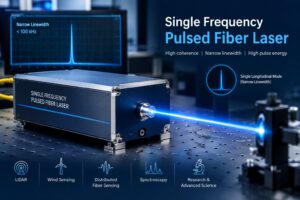
- The SPFL Series for single-frequency pulsed fiber laser performance
Engineering consultation is available for custom system development, OEM integration, and application-specific optimization.
Our Recommendation
The femtosecond fiber laser has changed what is possible in precision manufacturing and scientific research. Cold ablation, high peak power from a compact platform, excellent beam quality, and maintenance-free operation make these systems the preferred choice across semiconductors, aerospace, biomedical, and spectroscopy applications.
Whether the requirement is glass cutting, semiconductor processing, multiphoton microscopy, THz generation, or OEM integration into production equipment, Solid Laser’s ultrafast fiber laser portfolio delivers the performance and reliability modern applications demand.
FAQs About: Femtosecond Fiber Lasers
1. What is a femtosecond fiber laser and how does it differ from a regular laser?
2. How does passive mode locking generate ultrashort pulses in a femtosecond fiber laser?
3. What is the difference between a femtosecond vs picosecond laser for industrial micromachining?
4. What wavelengths do ytterbium and erbium femtosecond fiber lasers produce, and how do I choose between them?
5. What are the main advantages of a femtosecond fiber laser over a Ti:sapphire solid-state laser?
6. How does a femtosecond laser enable multiphoton microscopy for biomedical imaging?
7. What repetition rate should I choose for femtosecond laser processing applications?
8. Can femtosecond fiber lasers be used for OEM integration into production equipment?
9. How does femtosecond laser glass cutting work without cracking the glass?
10. What is a femtosecond laser frequency comb and why is it important for metrology?