Industries that work with metals, minerals, and advanced materials need fast answers about composition. A LIBS Laser Source delivers those answers in seconds. It fires a short, powerful pulse at a sample, creates a tiny plasma, and reads the light that plasma emits. The result is a full elemental breakdown without cutting, dissolving, or destroying the sample.
Laser-induced breakdown spectroscopy, or LIBS, has moved from research labs into mining sites, recycling yards, steel mills, and quality control lines. The technology owes much of this growth to modern laser engineering. Compact diode-pumped designs now pack serious pulse energy into rugged, portable modules. This article explains the top benefits of using a LIBS laser source, breaks down the laser technology behind it, and shows you what to look for when choosing a system for your own application.
What Is a LIBS Laser Source and How Does It Work?
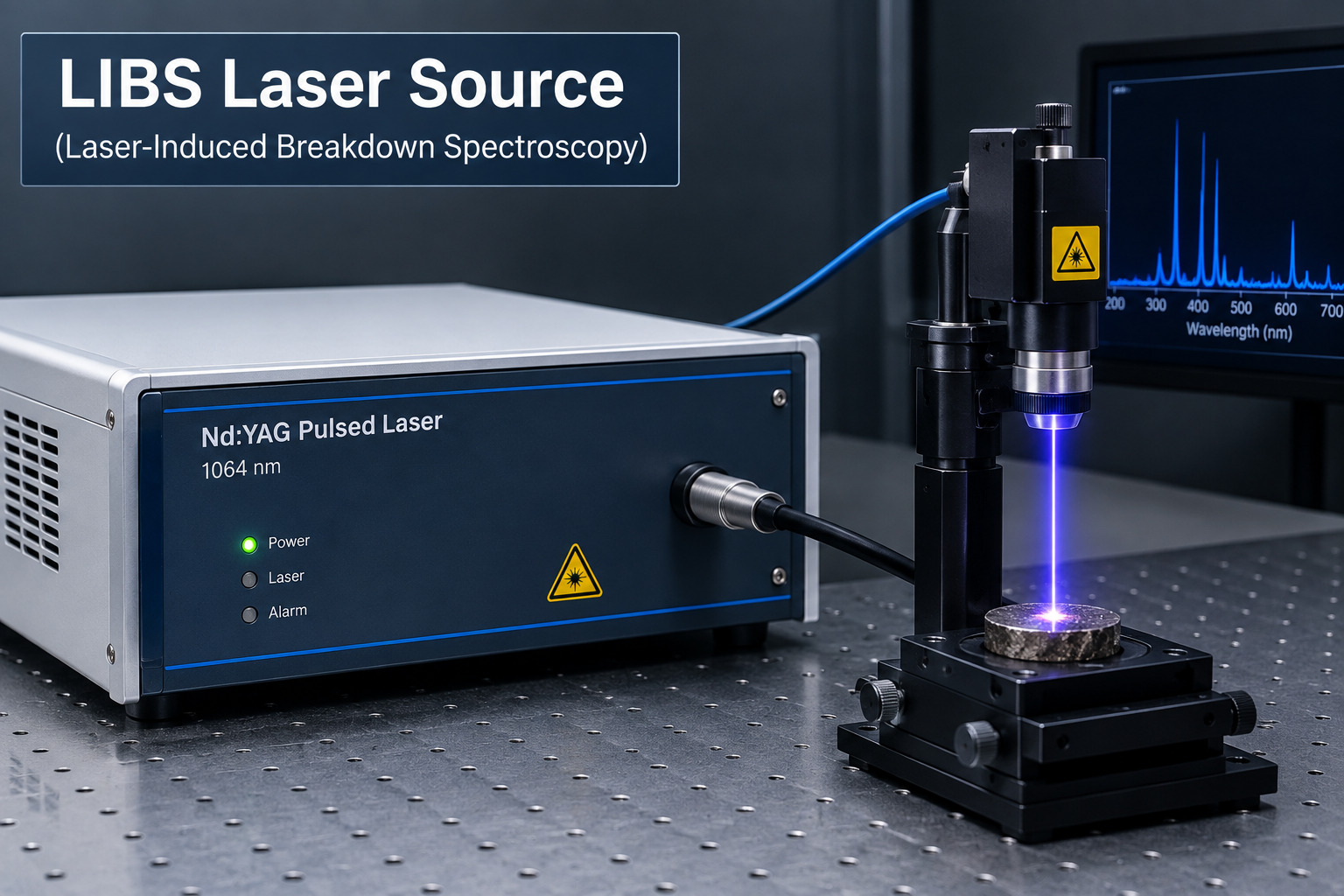
A LIBS laser source is the beating heart of any laser-induced breakdown spectroscopy system. It generates the high-peak-power pulse that makes the whole measurement possible. The process follows a simple sequence:
- Pulse delivery — the laser fires a focused pulse, often lasting only nanoseconds, onto the sample surface.
- Plasma formation — the pulse vaporizes a microscopic amount of material and turns it into a glowing plasma.
- Light emission — as the plasma cools, each element in the sample emits light at its own signature wavelengths.
- Spectral analysis — a spectrometer captures this light and software identifies every element present.
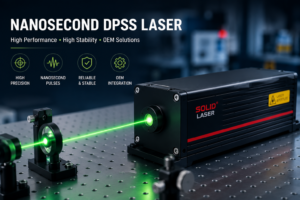
The entire cycle takes less than a second. Most systems rely on a nanosecond DPSS laser as the excitation source. DPSS stands for diode-pumped solid state, a design where laser diodes pump a solid crystal gain medium. This architecture gives LIBS systems the stability and compactness they need for real-world use.
Some advanced setups go a step further and use a sub-nanosecond pulsed laser. Shorter pulses concentrate energy into an even smaller time window. This raises peak power, improves plasma quality, and sharpens the spectral signal. Now that you know how the technology works, let’s look at why so many industries have adopted it.
Top Benefits of Using a LIBS Laser Source
LIBS has clear advantages over traditional lab-based analysis methods. Here are the benefits that matter most to engineers, plant managers, and researchers.
1. Real-Time Elemental Analysis
Traditional methods like ICP-MS or wet chemistry can take hours or even days. You collect a sample, ship it to a lab, and wait for results. A LIBS laser source gives you a full elemental readout in seconds, right where you stand. Mining crews sort ore on site. Recycling operators grade scrap metal on the conveyor. Steel producers verify alloy composition between production steps. Speed like this changes how entire operations run.
2. Little to No Sample Preparation
Most analytical techniques demand careful sample preparation. You grind, dissolve, or polish the material before testing begins. LIBS skips almost all of that work. The laser pulse handles everything by vaporizing a tiny spot on the raw surface. This saves labor hours, cuts consumable costs, and removes a common source of measurement error. Field teams especially value this benefit because proper sample prep is nearly impossible outdoors.
3. Non-Destructive Testing for Valuable Materials
The laser removes only nanograms to micrograms of material per pulse. The mark it leaves is often invisible to the naked eye. This makes LIBS ideal for testing valuable or irreplaceable items. Museums analyze historical artifacts without damaging them. Jewelers verify precious metal purity. Aerospace inspectors check finished components without compromising their integrity. Few other elemental analysis methods offer this level of care.
4. Detection of Light Elements
X-ray fluorescence (XRF) is a popular alternative to LIBS. However, XRF struggles with light elements such as lithium, beryllium, boron, and carbon. A LIBS laser source detects these elements with ease. This matters enormously right now. Lithium mining and battery recycling both depend on accurate lithium detection. Carbon measurement supports steel grading. LIBS fills an analytical gap that other portable methods simply cannot cover.
5. Compact and Field-Ready Design
Modern LIBS instruments fit in a handheld unit or a small benchtop box. Credit goes to advances in Diode-Pumped High Energy Lasers. These sources deliver millijoule-level pulse energy from modules small enough to hold in one hand. They run on battery power, resist vibration, and tolerate temperature swings. Older flashlamp-pumped lasers could never survive these conditions. Diode pumping made portable LIBS possible.
6. Low Operating Costs Over Time
A LIBS system needs no argon gas, no chemical reagents, and no consumable sample cups. The solid state laser at its core contains no gases or liquid dyes either. Diode pump modules last tens of thousands of hours. Once you own the system, each measurement costs almost nothing. Facilities running hundreds of tests per day see the savings add up fast. These six benefits explain the demand. The next question is what kind of laser makes them possible.
The Laser Technology Behind High-Performance LIBS
Not every laser can power a good LIBS measurement. The source must deliver high peak power, stable pulse energy, and consistent beam quality shot after shot. Let’s examine the technologies that meet this standard.
Why DPSS Architecture Dominates LIBS
A DPSS laser system uses laser diodes to pump a crystal such as Nd:YAG. The design converts electrical power into laser light with high efficiency. It also produces excellent beam quality, which helps the system focus energy into a tight spot on the sample. A tighter focus means a hotter, cleaner plasma and a stronger spectral signal.
Stability matters just as much. LIBS software compares emission intensities between elements. If pulse energy drifts between shots, the results drift too. A well-engineered solid-state pulsed laser holds pulse-to-pulse energy variation to a few percent or less. This consistency is what separates a research-grade instrument from a rough screening tool.
Nanosecond vs. Sub-Nanosecond Pulses
Pulse duration shapes the quality of the plasma. Here is how the two main options compare:
- Nanosecond DPSS laser — the industry workhorse. Pulses of 1 to 10 nanoseconds create robust plasmas suitable for most metals, minerals, and alloys. These lasers balance cost, energy, and reliability well.
- Short-pulse DPSS laser — pulses below one nanosecond raise peak power dramatically. The shorter interaction reduces heat spread into the sample. This produces cleaner ablation craters and lowers background continuum in the spectrum, which improves detection limits.
Researchers studying trace contaminants often choose a sub-nanosecond pulsed laser for exactly this reason. The reduced thermal effects also help when analyzing heat-sensitive materials such as polymers and pharmaceutical tablets. For a deeper look at the physics, the laser-induced breakdown spectroscopy literature covers plasma dynamics in detail.
Passively Q-Switched Microchip Designs
Many compact LIBS sources use passive Q-switching. A saturable absorber crystal inside the cavity releases energy in short, powerful bursts without any external driver electronics. This design shrinks the laser head, cuts power consumption, and improves ruggedness. Handheld LIBS analyzers almost always rely on this approach. It shows how smart optical engineering brought lab-grade analysis into the field.
Industries That Rely on LIBS Laser Sources Today
The benefits above translate into real value across a wide range of sectors:
- Mining and mineral exploration — geologists map ore grades in real time and make sorting decisions at the rock face instead of waiting on lab reports.
- Metal recycling — scrap yards identify alloy grades in seconds, which raises recovery value and keeps mixed metals out of melt batches.
- Steel and metallurgy — producers verify carbon content and alloy composition during production, catching errors before they become expensive.
- Battery and lithium supply chains — LIBS detects lithium directly, supporting everything from brine analysis to black mass recycling.
- Environmental monitoring — field teams screen soil and water for heavy metal contamination without transporting samples.
- Pharmaceutical quality control — manufacturers confirm elemental impurities and verify raw material identity on the production line.
- Space exploration — NASA’s ChemCam instrument on the Curiosity rover uses LIBS to analyze Martian rocks from a distance, proving the technology works even on another planet.
Each of these applications places different demands on the laser. That brings us to the practical question of how to choose the right source.
How to Choose the Right LIBS Laser Source
The laser you select determines the performance ceiling of your entire LIBS system. Work through these factors before you commit:
- Pulse energy — most LIBS work needs 1 to 50 millijoules per pulse. Harder materials and standoff distances demand more energy. Delicate samples need less.
- Pulse duration — decide between a standard nanosecond source and a short-pulse DPSS laser based on your detection limits and sample sensitivity.
- Repetition rate — higher rates enable signal averaging and faster mapping. Rates from 10 Hz to several kHz cover most applications.
- Beam quality — a clean, focusable beam creates a consistent plasma. Ask for real M² measurements, not just datasheet claims.
- Stability — request pulse-to-pulse energy stability data. Anything under 3% RMS supports quantitative analysis well.
- Size and integration support — OEM builders need compact modules with clear interface documentation and responsive engineering support.
Manufacturers who specialize in Diode-Pumped High Energy Lasers understand these trade-offs deeply. A good supplier will ask about your application first and recommend a configuration second. Treat that conversation as part of your evaluation.
Final Thoughts
A LIBS laser source turns elemental analysis from a slow lab procedure into an instant, on-site measurement. The benefits speak for themselves. You get real-time results, minimal sample preparation, non-destructive testing, light element detection, portable form factors, and low running costs. Advances in DPSS laser system engineering, from nanosecond workhorses to sub-nanosecond precision sources, keep pushing the technology into new industries every year.
Solid Laser builds purpose-designed laser sources for exactly these demands. The company’s solid state laser platforms cover LIBS excitation, precision measurement, and OEM integration, backed by engineering support from prototype through production. If your operation needs fast, reliable elemental analysis, a well-matched LIBS laser source is one of the smartest investments you can make.
FAQs About: LIBS Laser Sources
1. What type of laser is used in a LIBS Laser Source?
2. How much pulse energy does a LIBS Laser Source need?
3. Why choose a short-pulse DPSS laser for LIBS analysis?
4. Is a LIBS Laser Source suitable for OEM integration?
5. How does a solid-state pulsed laser compare to a flashlamp laser for LIBS?
6. Can a DPSS laser system be used for applications beyond LIBS?