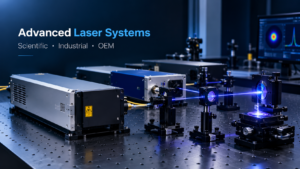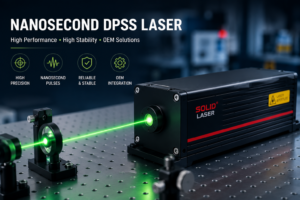
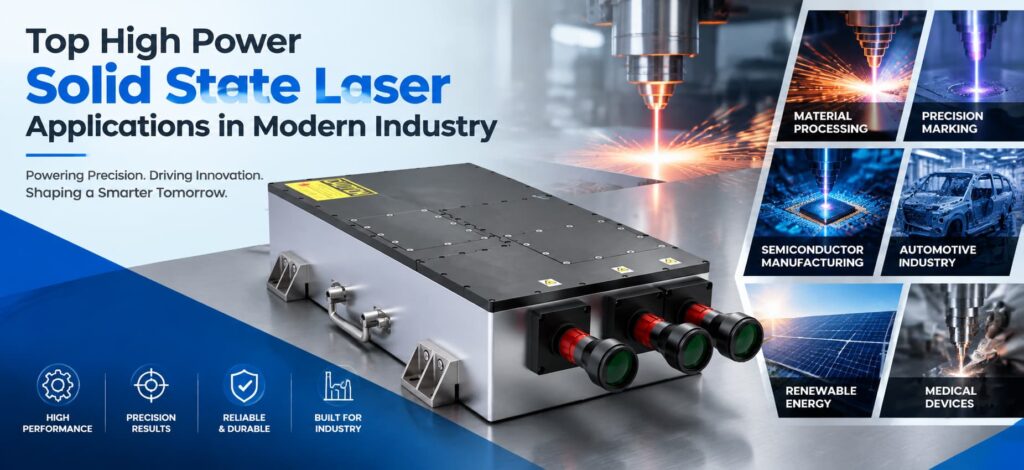
Lasers now sit at the core of modern industry, and few types carry as much weight as the high energy solid state laser. These systems power precision manufacturing lines, advanced defense platforms, and cutting-edge research labs, all while offering a level of stability that older laser technologies simply cannot match.
If you work in engineering, research, or industrial design, knowing where these lasers fit into today’s workflows helps you make smarter equipment decisions. This article covers the real-world applications of high power solid state lasers, explains the role of iodine-stabilized lasers, 3.5GHz frequency-shifted lasers, and ultraviolet Raman laser sources, and shows why industries keep adopting this technology.
What Makes High Power Solid State Lasers Different
A solid state laser uses a solid gain medium, often a crystal or glass doped with rare earth elements, instead of gas or liquid. This design brings clear advantages:
- Consistent beam quality — output stays stable even under heavy, continuous use.
- Fewer moving parts — the system needs less maintenance over its operating life.
- Scalable output power — power increases without sacrificing precision.
A high power solid state laser takes this further. Engineers push the output to levels suitable for cutting, welding, and other demanding tasks. These lasers deliver concentrated energy in a tight beam, letting manufacturers work with materials that resist traditional cutting tools, including hardened metals and certain ceramics.
Gas lasers need regular gas replenishment and complex cooling setups. Solid state lasers cut that overhead while improving reliability, which matters when a factory floor runs around the clock. So, where exactly is this technology being put to work?
Core Applications Across Modern Industry
Industries use these lasers for far more than cutting metal sheets.
Manufacturing and Material Processing
Manufacturing plants use high power solid state lasers for cutting, welding, drilling, and surface treatment. Automotive manufacturers cut body panels with tight precision, which reduces material waste and speeds up production. Aerospace companies weld turbine components that must withstand extreme heat, and laser welding gives them fine control that traditional methods cannot match.
Electronics manufacturers depend on these systems too. Circuit board etching, micro-drilling, and marking all require lasers that hold tight tolerances, since a small beam fluctuation can ruin an entire batch.
Defense, Aerospace, and Research
Military and aerospace programs use high energy solid state lasers for directed energy systems, targeting, and rangefinding. Field conditions demand extreme reliability, and solid state designs handle vibration and temperature swings better than gas lasers do.
Research labs rely on an iodine-stabilized laser when experiments need an extremely stable light source. These lasers lock their output frequency to a known absorption line in iodine vapor, giving scientists a dependable reference point. Metrology institutes use them worldwide to calibrate measurement equipment, since the NIST laser frequency standards program confirms iodine-stabilized systems remain among the most trusted methods for defining optical frequency standards.
3.5GHz Frequency-Shifted Lasers in Precision Research
Some applications need more than a stable frequency. They need a frequency shifted by a known, precise amount. A 3.5GHz frequency-shifted laser does exactly that, taking a stabilized base frequency and shifting it using an acousto-optic modulator or similar device.
Researchers use frequency-shifted lasers in laser interferometry, spectroscopy, and quantum optics. Shifting the frequency by 3.5GHz lets scientists create beat frequencies measurable with extreme precision, which supports experiments detecting tiny changes in distance, velocity, or atomic behavior.
Telecommunications testing benefits too. Engineers use a known frequency offset to validate how fiber optic equipment responds to specific signal changes, catching design flaws before products reach the market.
Ultraviolet Raman Laser Sources in Modern Research
Raman spectroscopy needs a light source with a short wavelength and a stable output, and this is where an ultraviolet Raman laser source earns its place. UV excitation boosts Raman signal strength for many materials and helps researchers avoid fluorescence interference that often muddies results at longer wavelengths.
Pharmaceutical labs use UV Raman systems to identify chemical compounds and verify drug purity. Semiconductor researchers use them to study material composition at extremely fine scales. Environmental scientists rely on them to detect trace contaminants in water and soil samples.
Solid-Laser offers a dedicated UV Raman laser source series built for these exact demands, giving research teams a reliable option without needing to build a custom UV excitation setup from scratch. Teams working in analytical chemistry or materials science often find this shortens both setup time and troubleshooting later on. Beyond the applications themselves, there are clear reasons this shift keeps accelerating.
Why Industries Keep Shifting Toward Solid State Lasers
A few advantages come up again and again when facilities explain the switch:
- Lower operating costs — solid state systems skip the regular gas refills that add up over time, so facilities running multiple lasers save real money.
- Better beam quality — manufacturing tolerances have tightened across most industries, and a cleaner, more focused beam produces fewer defects.
- Compact design — solid state lasers generally take up less room than comparable gas systems, which helps facilities where floor space carries a real cost.
A report from SPIE, the international society for optics and photonics, tracks steady growth in solid state laser adoption across manufacturing and defense sectors, tied directly to these efficiency gains. With the benefits clear, the next question is how to pick the right system.
Choosing the Right Laser for Your Application
Before committing to a system, work through these factors in order:
- Power output — cutting thick industrial metal calls for higher output than fine engraving does. Buying more power than the job requires wastes money and adds unnecessary heat management challenges.
- Beam quality requirements — some tasks tolerate a less focused beam, while semiconductor fabrication demands near-perfect beam characteristics.
- Operating environment — a laser built for rugged field use needs different housing than one sitting in a climate-controlled lab. Vibration resistance, temperature range, and dust protection all factor into the decision.
- Long-term support — a high power solid state laser is a serious investment, so working with a manufacturer who understands your industry’s demands makes the whole process smoother.
Final Thoughts
High power solid state lasers have earned their place across manufacturing floors, defense programs, and research labs, delivering the stability, precision, and efficiency modern industry demands. Whether a team needs an iodine-stabilized laser for reference-grade metrology, a 3.5GHz frequency-shifted laser for advanced spectroscopy, or an ultraviolet Raman laser source for chemical analysis, solid state technology gives engineers a dependable foundation to build on.
Companies exploring their options can review what Solid-Laser offers, since the company focuses specifically on precision laser systems built for demanding industrial and scientific work. Choosing a proven supplier makes a real difference when accuracy and reliability cannot be compromised.