Industrial laser buyers face a crowded market, yet one technology keeps rising to the top of serious shortlists. A High Energy DPSS laser combines millijoule-to-joule pulse energy with the stability and compactness that modern production lines demand. These diode-pumped solid state systems power semiconductor processing, LiDAR, spectroscopy, scientific research, and defense platforms worldwide.
Not every DPSS laser deserves the “high energy” label, though. Real differences separate a system that holds its specifications for years from one that drifts after a few thousand hours. This guide explains how high energy DPSS technology works, which system types fit which industrial jobs, and what to check before you buy. You will also see where related technologies, such as DPSS UV lasers and hundred joule-class pulsed lasers, fit into the picture.
What Is a High Energy DPSS Laser?
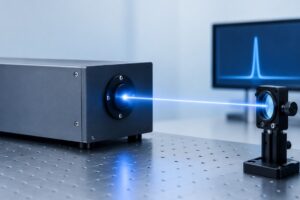
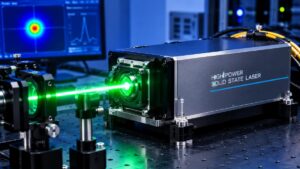
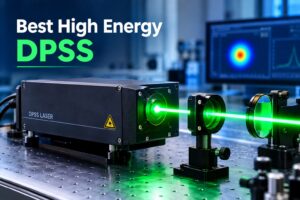
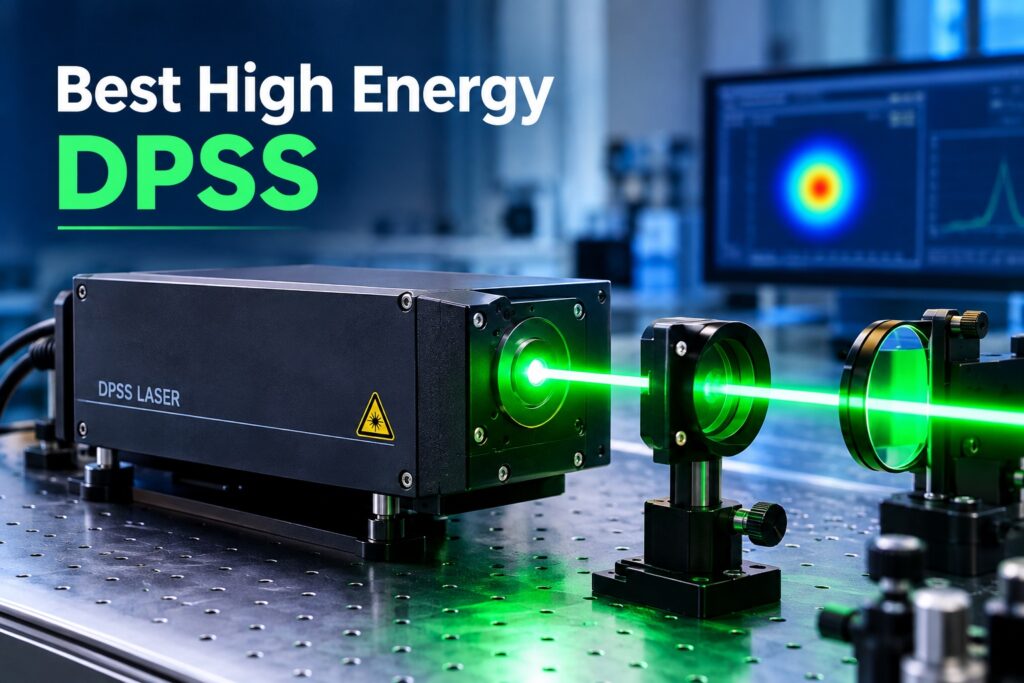
DPSS stands for diode-pumped solid state. In this design, laser diodes pump a solid crystal gain medium, usually Nd:YAG, Nd:YVO4, or Yb-doped materials. The crystal stores that pump energy and releases it as a powerful, clean laser pulse. A high energy DPSS laser pushes this architecture to deliver tens of millijoules up to multiple joules per pulse.
The diode-pumped approach replaced older flashlamp-pumped designs for good reasons:
- Efficiency — diodes convert electricity to pump light far better than flashlamps, which cuts power bills and cooling demands.
- Lifetime — pump diodes last tens of thousands of hours. Flashlamps need replacement every few hundred hours.
- Stability — diode pumping produces less heat distortion in the crystal, so beam quality and pulse energy stay consistent.
- Compactness — removing bulky lamp power supplies shrinks the whole system, which matters for OEM integration.
Within the high energy DPSS family, several configurations serve different needs. Single longitudinal mode (SLM) systems add narrow linewidth for coherent applications. Frequency-converted systems generate green and UV output for precision processing. Amplified chains scale energy toward the joule class and beyond. Understanding these branches helps you match a system to your actual job, which the next section covers.
The Best High Energy DPSS Laser System Types for Industry
Different industrial tasks call for different system architectures. Here are the configurations that deliver the most value in 2026.
1. Single Longitudinal Mode (SLM) High Energy Systems
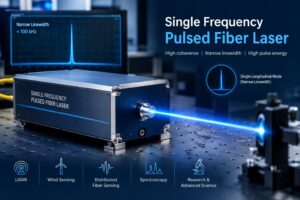
An SLM system emits one pure optical frequency with extremely narrow linewidth. Combine that with high pulse energy and you get the ideal source for coherent LiDAR, Doppler wind measurement, and high-resolution spectroscopy. The SHSL-SLM class of lasers delivers exactly this combination. Injection seeding locks the pulse to a stable reference, so every shot carries the same clean frequency. Buyers in remote sensing and nonlinear optics research should start their search here.
2. High Repetition Rate Industrial Systems
Factory throughput depends on pulses per second. High repetition DPSS systems run from hundreds of hertz into the kilohertz range while holding stable pulse energy. Production lines use them for drilling, scribing, marking, and surface treatment. The engineering challenge is thermal management. A well-built system keeps beam quality steady even at full duty cycle, hour after hour. Ask any supplier for beam data at your target repetition rate, not just at the datasheet sweet spot.
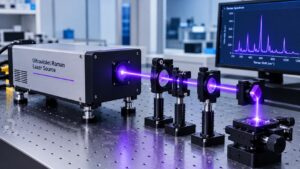
3. Frequency-Converted DPSS UV Lasers
Many materials absorb ultraviolet light far better than infrared. Nonlinear crystals convert the fundamental 1064 nm output to 355 nm or 266 nm, creating DPSS UV Lasers for cold processing. The short wavelength removes material with minimal heat damage. Semiconductor fabs use these systems for wafer dicing and via drilling. Electronics manufacturers rely on them for fine marking on plastics and glass. Medical device makers machine delicate polymers that infrared lasers would melt.
4. Joule-Class and Hundred Joule-Class Pulsed Systems
At the top of the energy scale sit amplified systems that reach joules, tens of joules, and beyond. A Hundred Joule-class Pulsed Laser serves laser shock peening, plasma physics research, and inertial fusion energy programs. These systems chain a stable oscillator through multiple amplifier stages. Diode pumping at this scale was once impossible, but modern diode arrays now power research facilities worldwide. Programs like the work at Lawrence Livermore National Laboratory show where this energy class is heading.
5. Compact OEM Modules for Integration
Instrument builders need lasers that disappear inside their products. Compact high energy modules deliver millijoule pulses from palm-sized packages. LIBS analyzers, rangefinders, and portable sensing instruments all depend on this format. Look for sealed optical cavities, conductive cooling options, and clean digital control interfaces when evaluating OEM modules.
Key Specifications That Separate Great Systems from Average Ones
Datasheets all look impressive. These are the numbers that actually predict long-term performance:
- Pulse energy stability — demand pulse-to-pulse variation under 2 to 3% RMS. Unstable energy ruins process repeatability and measurement accuracy.
- Beam quality (M²) — a value near 1 means the beam focuses to the smallest possible spot. Ask for measured M² data at full energy.
- Linewidth — coherent applications need SLM operation with kilohertz-to-megahertz linewidth. Confirm the seeding success rate too.
- Pointing stability — beam drift over temperature kills alignment in deployed systems. Check the microradian specification.
- Pulse duration options — nanosecond pulses suit most industrial work. Sub-nanosecond options raise peak power for ablation and LIBS.
- Service intervals — ask when diodes need replacement and what that service costs. Lifetime economics matter more than purchase price.
A trustworthy manufacturer shares real test data for every one of these points. Treat reluctance as a warning sign. Purpose-built platforms such as the SHSL-SLM series publish the stability and linewidth figures that coherent applications depend on, which makes supplier comparison much easier. With specifications covered, let’s look at where these systems earn their keep.
Industrial Applications Driving Demand in 2026
High energy DPSS technology has spread across nearly every advanced industry:
- Coherent LiDAR and wind sensing — SLM systems provide the narrow linewidth that Doppler measurement requires, supporting wind farms, airports, and meteorology networks.
- Semiconductor manufacturing — DPSS UV lasers handle wafer dicing, via drilling, and defect inspection where precision defines yield.
- LIBS elemental analysis — compact high energy modules create the plasma that laser-induced breakdown spectroscopy reads, serving mining, recycling, and metallurgy.
- Laser shock peening — joule-class pulses harden turbine blades and aircraft components by driving compressive stress into metal surfaces.
- Scientific research — universities and national labs pump optical parametric oscillators, probe plasmas, and run nonlinear optics experiments with these sources. Resources from SPIE track the research applications in depth.
- Defense and rangefinding — rugged DPSS designs survive vibration and temperature extremes that field deployment demands.
- Medical device manufacturing — UV and short-pulse systems machine stents, catheters, and implants without thermal damage.
Each application stresses different specifications. That makes the next section, choosing your system, the most important part of this guide.
How to Choose the Right High Energy DPSS Laser
Work through these steps in order and your shortlist will almost build itself.
Step 1: Define Your Process Requirements
Start with the physics of your job. What pulse energy does your process actually need? What wavelength does your material absorb best? How many pulses per second does your throughput target demand? Write these numbers down before you contact any supplier. Buying more energy than you need wastes money and complicates thermal management.
Step 2: Match the Architecture to the Application
Coherent sensing points you toward SLM systems. Cold material processing points toward UV conversion. Extreme energy research points toward amplified joule-class chains. OEM instruments point toward compact sealed modules. The architecture decision narrows the field faster than any other choice.
Step 3: Evaluate the Manufacturer, Not Just the Laser
A laser is a long-term relationship. Check how long the company has built high energy systems. Ask for customer references in your industry. Review warranty terms for pump diodes, since these are the main consumable. Confirm response times for service requests. A supplier who offers concept design, prototyping, and custom manufacturing can grow with your project instead of limiting it.
Final Thoughts
The best high energy DPSS laser systems share the same DNA. They hold pulse energy steady, deliver clean beams, run for tens of thousands of hours, and come from manufacturers who stand behind their engineering. SLM systems lead in coherent sensing. UV-converted systems dominate precision processing. Joule-class and hundred joule-class platforms push the frontiers of research and heavy industry.
Solid Laser builds its reputation on exactly these fundamentals. The company’s High Energy DPSS laser platforms serve LiDAR, spectroscopy, industrial processing, and OEM customers with single frequency stability and proven energy performance. Define your requirements, demand real test data, and choose a partner with genuine engineering depth. Your production line or research program will benefit for years.
FAQs About: High Energy DPSS Laser Systems
1. What qualifies as a High Energy DPSS laser?
2. What are DPSS UV Lasers used for in manufacturing?
3. What is a Hundred Joule-class Pulsed Laser used for?
4. Why does single longitudinal mode operation matter in a High Energy DPSS laser?
Single longitudinal mode operation means the laser emits one pure optical frequency with very narrow linewidth. Coherent applications depend on this purity. Doppler LiDAR,