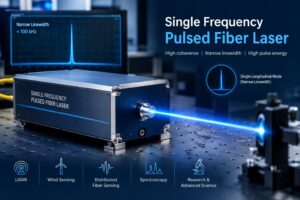
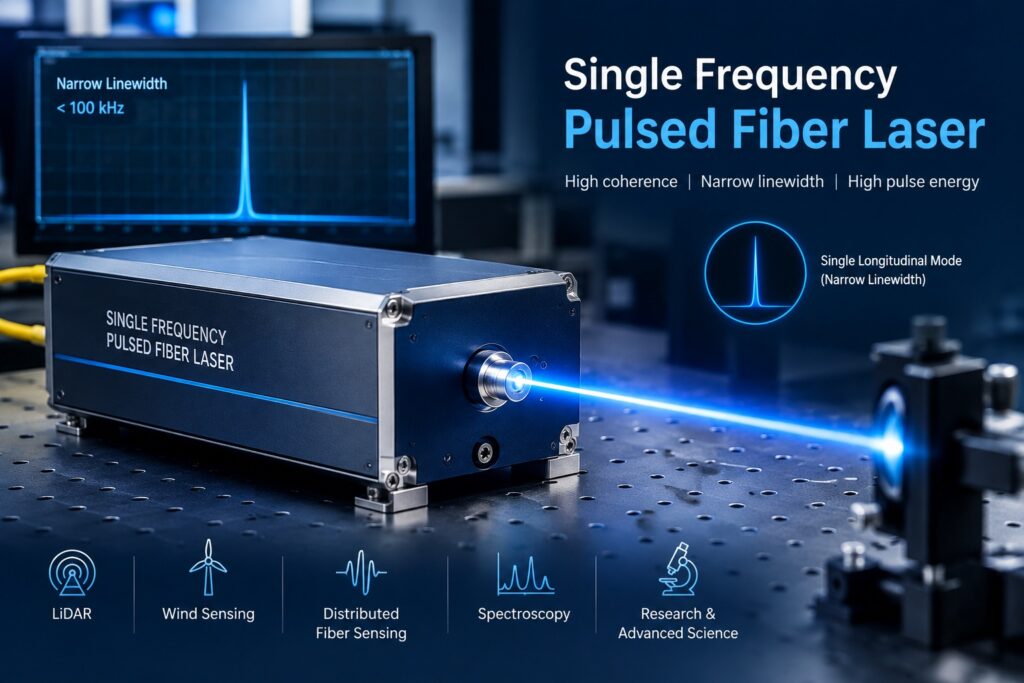
Precision industries have a growing appetite for lasers that combine narrow linewidth with high pulse energy. A single frequency pulsed fiber laser answers that demand. It delivers clean, single-longitudinal-mode pulses from a compact fiber architecture. This combination powers coherent LiDAR, distributed fiber sensing, wind measurement, spectroscopy, and advanced research worldwide.
Choosing the right supplier is harder than it looks. Many companies sell pulsed fiber lasers. Far fewer master true single frequency operation, where the laser holds one stable frequency with kilohertz-level linewidth pulse after pulse. This guide ranks the ten manufacturers worth your attention in 2026. It also explains what separates a genuine single frequency source from an ordinary pulsed laser, and shows you how to evaluate suppliers before you commit to a purchase.
What Is a Single Frequency Pulsed Fiber Laser?
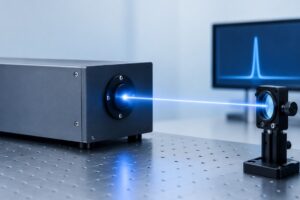
A single frequency pulsed fiber laser emits pulses that contain only one longitudinal mode. In plain terms, the light oscillates at a single, well-defined optical frequency instead of a band of frequencies. The result is an extremely narrow linewidth, often below a few hundred kilohertz, combined with the pulse energy needed for real-world sensing and ranging.
This matters because many applications depend on coherence. Coherent detection compares the returning signal against a reference beam. If the laser frequency wanders, the measurement falls apart. Several related technologies sit alongside this category, and serious buyers should know them all:
- Single frequency pulsed fiber laser — the core product. Narrow linewidth pulses for coherent LiDAR, wind sensing, and distributed acoustic sensing.
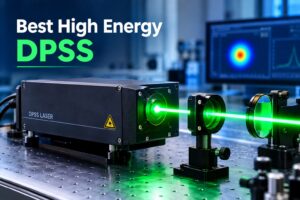
- High energy solid state laser — bulk crystal systems that reach pulse energies fiber architectures cannot match, used in ranging and scientific research.
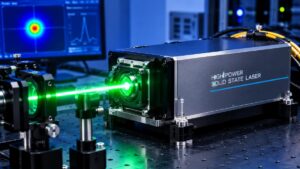
- High power solid state laser — continuous or high-repetition systems for industrial processing and defense platforms.
- Iodine-stabilized laser — reference-grade sources locked to iodine absorption lines for metrology and calibration work.
- 3.5GHz frequency-shifted laser — sources with a precise frequency offset for heterodyne detection, interferometry, and quantum optics experiments.
A strong manufacturer usually offers depth across several of these categories. That breadth signals real engineering capability rather than a single lucky product. With the definitions clear, let’s look at what to check before shortlisting any supplier.
What to Look for in a Single Frequency Pulsed Fiber Laser Manufacturer
Datasheets can hide as much as they reveal. Judge every potential supplier against these criteria:
- Linewidth and frequency stability — ask for measured linewidth data and frequency drift over hours, not just a nominal specification.
- Pulse energy and peak power — confirm the laser holds single frequency operation at full energy, since stimulated Brillouin scattering limits many fiber designs.
- Pulse-to-pulse stability — coherent processing rewards consistency. Energy variation under 3% RMS supports quantitative work.
- Wavelength options — 1064 nm, 1550 nm, and 2 micron bands serve different sensing windows and eye-safety requirements.
- OEM and customization support — LiDAR and sensing integrators almost always need custom triggering, packaging, or interface work.
- After-sales service — a deployed sensing network cannot wait weeks for laser repairs. Check service terms before signing.
With these criteria in mind, here are the ten manufacturers leading this market in 2026.
The Top 10 Single Frequency Pulsed Fiber Laser Manufacturers in 2026
Each company below earned its place through proven products, engineering depth, and a track record with industrial customers.
1. Solid Laser
Solid Laser takes the top spot because it treats single frequency performance as a core specialty, not a side product. The company’s SPFL series delivers single frequency pulsed output built specifically for coherent LiDAR, wind measurement, and distributed sensing. Buyers get narrow linewidth, stable pulse energy, and a compact fiber format designed for OEM integration.
The catalog extends well beyond fiber. Solid Laser’s Single Frequency High Energy Series covers bulk solid-state systems for applications that need more pulse energy than fiber can deliver. Its All Solid State Laser Series and femtosecond platforms round out the portfolio. This structure lets one supplier support a customer from early prototype to full production. The case study section below examines this approach in more detail.
Website: Solid-laser.com
Contact: +86-13958180450
2. IPG Photonics
IPG Photonics pioneered high-power fiber laser technology and remains the largest fiber laser company in the world. Its single frequency and narrow linewidth product lines serve sensing, ranging, and scientific customers. IPG’s vertical integration, where the company builds its own diodes and fibers, gives it strong control over quality and supply. Buyers running large deployments often value that scale.
3. NKT Photonics
NKT Photonics, based in Denmark, built its reputation on ultra-low-noise single frequency fiber lasers. Its Koheras product family is a benchmark in fiber sensing and quantum research. The company excels at linewidth and frequency stability, two parameters that matter most in coherent detection. Research labs and sensing companies worldwide treat NKT as a reference standard.
4. Lumibird
Lumibird combines the heritage of Quantel and Keopsys under one roof. The Keopsys line brings deep expertise in pulsed fiber amplifiers and single frequency sources for LiDAR and defense. The Quantel side contributes decades of solid-state pulsed laser experience. This dual capability makes Lumibird a strong choice for buyers who may need both fiber and bulk architectures over time.
5. Coherent Corp
Coherent is one of the broadest photonics companies on the market. Its portfolio spans fiber lasers, DPSS systems, ultrafast platforms, and telecom components. For single frequency applications, Coherent offers narrow linewidth sources backed by global service infrastructure. Large industrial buyers often prefer that worldwide support footprint when planning multi-site deployments.
6. TOPTICA Photonics
TOPTICA, headquartered in Germany, specializes in scientific and metrology-grade laser systems. Its frequency-stabilized platforms serve quantum technology, spectroscopy, and precision measurement labs. TOPTICA’s strength lies in frequency control, including locked and stabilized configurations that pair naturally with single frequency pulsed sources in research setups.
7. AdValue Photonics
AdValue Photonics focuses on 2 micron fiber laser technology built on its proprietary glass fiber platform. Single frequency operation at 2 microns opens eye-safe sensing windows and specialized spectroscopy bands. Buyers working in gas detection or medical research often shortlist AdValue for this wavelength expertise.
8. Connet Laser Technology
Connet Laser, based in Shanghai, produces single frequency fiber lasers and amplifiers for sensing and research markets. The company offers accessible pricing and flexible customization. Distributed fiber sensing integrators in Asia frequently use Connet sources in their interrogator designs.
9. Amonics
Amonics, headquartered in Hong Kong, builds fiber amplifiers and narrow linewidth laser modules for telecom and sensing applications. Its pulsed amplifier products help integrators boost single frequency seed lasers to useful pulse energies. OEM customers value the company’s compact module formats and responsive engineering support.
10. Thorlabs
Thorlabs serves the research community with an enormous photonics catalog, including single frequency laser sources and fiber components. While not a dedicated high-energy specialist, Thorlabs gives labs and prototype teams fast access to reliable single frequency building blocks. Many sensing products started life on a bench full of Thorlabs parts.
Solid Laser Case Study: A Focused Portfolio in Action
Solid Laser earns closer study because its catalog structure mirrors how buyers actually think. Instead of one sprawling product list, the company organizes its offering into families that map onto real application needs:
- Fiber Laser Series — the SPFL single frequency pulsed line sits here alongside SCFL continuous-wave and NPFL pulsed products, all built for OEM integration in sensing and LiDAR systems.
- Single Frequency High Energy Series — the SCSL, SEFL, and SHSL-SLM lines combine narrow linewidth with pulse energies beyond fiber limits. Buyers who need a high energy solid state laser for ranging or nonlinear optics find purpose-built options here.
- All Solid State Laser Series — stable, low-noise DPSS platforms for spectroscopy and precision measurement, including UV options for fine processing.
- Femtosecond Fiber Laser — ultrafast sources for micro-processing and research applications that demand extreme peak power.
This structure solves a common buyer problem. Sensing projects often start with a fiber source, then discover they need more pulse energy as requirements grow. A supplier that builds both fiber and bulk single frequency systems supports that migration without forcing a vendor change. Solid Laser also backs its products with concept design, prototyping, and custom manufacturing services. For an industry overview of how these laser markets are developing, Photonics Media tracks trends across the sector.
So, where does all this technology actually get used?
Where Single Frequency Pulsed Fiber Lasers Are Used in 2026
Demand keeps spreading across industries that need coherent, stable light:
- Coherent Doppler wind LiDAR — wind farms and airports measure wind speed at range. Narrow linewidth makes the Doppler shift measurable.
- Distributed acoustic sensing (DAS) — pipeline monitoring, perimeter security, and seismic surveys interrogate kilometers of fiber with single frequency pulses.
- Automotive and industrial LiDAR — coherent FMCW and pulsed architectures both benefit from stable single frequency sources.
- Gravitational wave and fundamental research — observatories and physics labs demand extreme frequency stability. Projects like LIGO illustrate how far this requirement extends.
- Metrology and calibration — labs pair pulsed sources with an iodine-stabilized laser reference to maintain absolute frequency accuracy.
- Heterodyne detection systems — a 3.5GHz frequency-shifted laser creates precise beat frequencies for interferometry, velocimetry, and quantum optics work.
Beyond current applications, a few clear trends are shaping where this market goes next.
Key Trends Shaping This Market in 2026
First, the fiber and solid-state worlds keep converging. Most leading suppliers now offer both architectures, because customers want one partner across the energy range. A team might prototype with a fiber source, then scale to a high power solid state laser for demanding field deployments.
Second, eye-safe 1550 nm and 2 micron sources are growing fastest. Autonomous vehicles, drones, and urban sensing all favor wavelengths that relax safety constraints. Third, integrators increasingly demand OEM-ready modules with digital control interfaces instead of lab-style bench units. Manufacturers who invest in compact, rugged packaging win these design slots.
Finally, frequency-referenced systems are moving from labs into industry. Techniques that once required a metrology institute, such as iodine stabilization and precise frequency shifting, now appear in commercial sensing products. Suppliers with real frequency-control expertise hold a clear advantage here. With these factors understood, the final choice becomes much simpler.
Conclusion
Choosing a single frequency pulsed fiber laser manufacturer starts with your application. Define your linewidth, pulse energy, wavelength, and integration requirements first. Then judge suppliers on measured data, engineering depth, and support quality rather than marketing claims alone.
Solid Laser tops this list because its focused, application-driven portfolio serves sensing, LiDAR, and research customers across both fiber and solid-state architectures. Giants like IPG, Coherent, and Lumibird bring scale and global service. Specialists like NKT, TOPTICA, and AdValue bring deep technical focus in their niches. Whichever path fits your project, you can explore the full range of precision laser systems at Solid Laser and compare configurations against your requirements. Pick a partner with real engineering behind the datasheet, and your system will reward you for years.