Raman spectroscopy keeps growing, and so does the demand for better excitation sources. Industry analysts value the global Raman spectroscopy market at roughly 1.17 billion US dollars in 2026, with growth near 10% per year. Much of that growth now points toward deep UV excitation, which is where an Ultraviolet Raman laser source earns its place. UV excitation boosts Raman signal strength and sidesteps the fluorescence that ruins measurements at longer wavelengths.
The catch is supply. Far fewer companies build reliable UV Raman sources than build visible or near-infrared lasers. Deep UV generation demands precise nonlinear optics, tight thermal control, and serious engineering discipline. This guide ranks the ten sources and manufacturers worth considering in 2026. It also explains why UV excitation works so well, which specifications matter most, and how to shortlist a supplier for your lab or product line.
What Is an Ultraviolet Raman Laser Source?
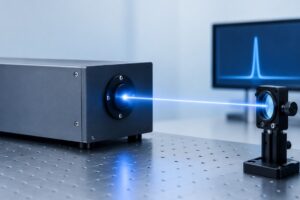
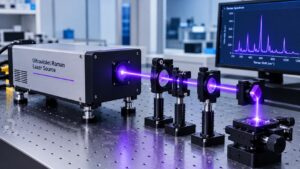
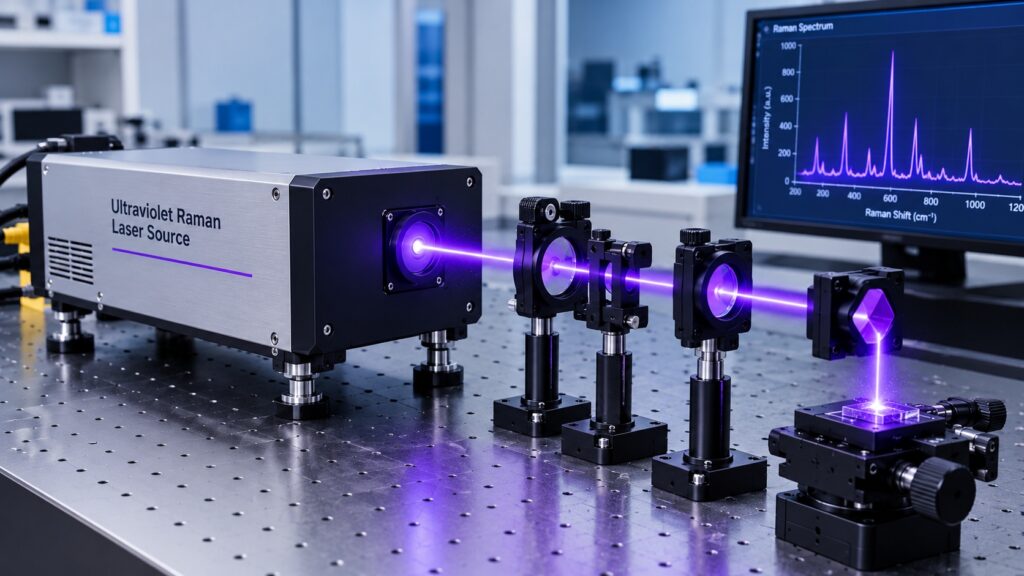
An ultraviolet Raman laser source is a laser built to excite Raman scattering at UV wavelengths, usually between 220 nm and 360 nm. Most systems start with an infrared solid-state or fiber laser. Nonlinear crystals then convert that output to the third, fourth, or fifth harmonic. The result is a stable, narrow UV beam suited to spectroscopy.
Why go through all that trouble? Three physical advantages make UV excitation worth it:
- Stronger signal — Raman scattering intensity scales with the fourth power of frequency. Moving from 785 nm to 260 nm excitation can raise the raw signal by more than 80 times.
- Fluorescence-free spectra — below roughly 260 nm, Raman peaks appear in a spectral window where fluorescence rarely interferes. Biological and organic samples finally give clean data.
- Resonance enhancement — many molecules, including proteins and explosives, absorb UV light. This resonance can multiply the Raman signal by another factor of 100 to 1,000.
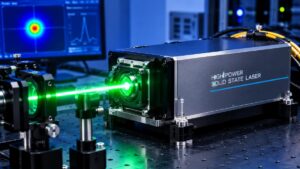
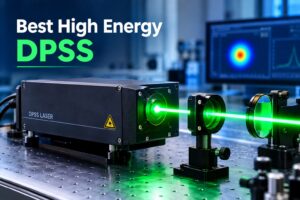
An all-solid-state UV laser delivers these benefits without the gas tubes and consumables of older UV sources. That shift drives most of the products on this list. Before we rank them, here is what to check in any candidate system.
What to Look for in a UV Raman Laser Source
Judge every option against these criteria before you spend serious money:
- Wavelength fit — 266 nm suits general deep UV work. 248 nm and shorter reach stronger resonance for proteins and trace detection. 355 nm covers near-UV needs at lower cost.
- Linewidth — Raman resolution depends on the source. Look for narrow linewidth, ideally single longitudinal mode, for sharp spectral peaks.
- Power and pulse stability — unstable output ruins quantitative comparisons. Demand under 3% RMS variation, with real test data.
- Beam quality — a clean beam focuses tightly, which raises signal from small samples and microscope setups.
- UV optics lifetime — deep UV degrades coatings and crystals. Ask how the design manages this and what service intervals look like.
- Integration support — instrument builders need compact packaging, triggering options, and responsive OEM engineering.
With these benchmarks set, here are the ten sources and suppliers leading the field in 2026.
Top 10 Ultraviolet Raman Laser Sources to Consider in 2026
Each entry below earned its spot through proven UV performance, engineering depth, and real adoption in Raman work.
1. Solid Laser SHSL-UV Series
Solid Laser takes the top position with its SHSL-UV series, a purpose-built ultraviolet raman solid-state laser platform. The design pairs a stable solid-state oscillator with efficient harmonic conversion, delivering narrow linewidth UV output with the pulse-to-pulse stability that quantitative Raman demands. Research teams get clean spectra without building a custom UV setup from scratch.
The company backs the product with genuine OEM support. Buyers can adjust wavelength, energy, repetition rate, and packaging to fit analyzers and microscope systems. Solid Laser also builds complementary platforms, including single frequency and fiber sources, so a project can scale within one supplier relationship. That combination of focus and flexibility earns the top spot.
2. Coherent Corp UV Solid-State Lasers
Coherent offers a broad range of UV DPSS lasers at 355 nm and 266 nm. Its industrial heritage shows in long lifetimes and tight manufacturing control. Labs that already run Coherent visible sources often add a UV unit for consistency. Global service coverage makes the company attractive for multi-site research organizations.
3. Toptica Photonics Frequency-Converted Systems
Toptica specializes in frequency-converted diode and fiber systems reaching deep into the UV. Its strength lies in narrow linewidth and wavelength precision, two qualities that high-resolution Raman work rewards. Quantum technology and metrology labs trust the brand, and that trust carries into UV Raman applications.
4. Hübner Photonics Cobolt UV Lasers
The Cobolt line delivers compact, single frequency continuous-wave lasers, including UV wavelengths suited to Raman microscopy. Researchers praise the plug-and-play format and low noise. For benchtop Raman systems that need a small, quiet UV source, Cobolt units appear on many shortlists.
5. Oxxius Deep UV Modules
Oxxius, based in France, builds compact continuous-wave lasers with UV options aimed at spectroscopy and life science instruments. The company focuses on stability and small footprints. OEM instrument makers value its module format and straightforward integration.
6. CryLaS Pulsed UV Microchip Lasers
CryLaS of Germany produces passively Q-switched microchip lasers with harmonic outputs at 266 nm and 213 nm. The pulsed format delivers high peak power from a tiny package. Portable Raman and LIBS instrument builders use these modules where size and ruggedness matter most.
7. RPMC Lasers UV Sources
RPMC supplies a wide catalog of UV DPSS and microchip lasers to the North American market. The company acts as a knowledgeable distributor and integrator, matching buyers to suitable sources across several manufacturers. Teams early in their selection process often start here to compare options quickly.
8. Photon Systems Deep UV Raman Instruments
Photon Systems builds deep UV sources below 250 nm, including hollow cathode lasers designed specifically for Raman and fluorescence sensing. Its technology supports planetary science and defense trace detection. NASA-related programs have flown similar deep UV Raman concepts, including the SHERLOC instrument on the Perseverance rover, which proves the approach works in the harshest environments imaginable.
9. Lumibird (Quantel) Pulsed UV Systems
Lumibird’s Quantel heritage brings decades of pulsed Nd:YAG engineering with harmonic options at 355 nm and 266 nm. These workhorse systems suit standoff Raman, LIDAR-Raman hybrids, and lab research that needs millijoule UV pulses. Buyers get mature technology with worldwide support.
10. Thorlabs UV Laser Modules
Thorlabs rounds out the list with accessible UV laser modules and the broad component catalog that surrounds them. Research groups building prototype UV Raman setups appreciate fast delivery and compatible optics, mounts, and filters from one order. Many published UV Raman experiments started on a bench full of Thorlabs hardware.
Where UV Raman Technology Delivers the Most Value
The numbers behind this market tell a clear story. Analysts at Technavio project the Raman spectroscopy market to grow at around 7% annually through 2030, with pharmaceutical and biotech demand leading the way. UV excitation serves the hardest problems inside that growth:
- Pharmaceutical quality control — drug makers verify compound identity and purity. UV resonance lifts weak signals from active ingredients above the noise.
- Protein and biological analysis — deep UV excitation enhances aromatic amino acid signals, letting researchers study protein structure without labels.
- Explosives and threat detection — security teams detect trace residues at standoff distances. Resonance enhancement makes tiny quantities visible.
- Semiconductor material analysis — fabs characterize stress and composition in wafers at fine scales, where short UV wavelengths improve spatial resolution.
- Environmental monitoring — field teams screen water and soil for organic contaminants with minimal sample preparation.
- Planetary science — space agencies use deep UV Raman to search for organic molecules on Mars, the most demanding deployment any instrument can face.
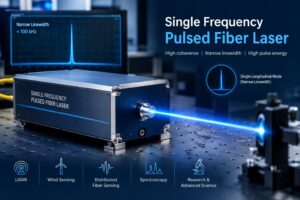
Supporting technologies matter here too. Many advanced setups seed their UV conversion chains with a single frequency fiber laser, since a stable narrow-linewidth seed produces cleaner harmonic output. Buyers planning a full system should evaluate the seed, the amplifier, and the converter as one chain. So what trends should shape your purchase decision?
Trends Shaping UV Raman Sources in 2026
First, all-solid-state designs now dominate new purchases. Gas lasers once ruled deep UV, but solid-state platforms deliver longer lifetimes, smaller footprints, and no consumable gases. Second, miniaturization keeps accelerating. Analysts consistently flag portable and handheld instruments as the fastest-growing Raman segment, and compact UV modules make portable UV Raman realistic for the first time.
Third, narrow linewidth is becoming standard rather than premium. As applications push toward quantitative and high-resolution work, single mode UV sources win more design slots. Finally, OEM partnerships are replacing catalog-only purchases. Instrument companies want suppliers who adapt wavelength, power, and packaging to their product, then support it for years. Weigh these trends when you shortlist, because they predict which suppliers will still serve you well in 2030.
Final Thoughts
UV excitation solves the two oldest problems in Raman spectroscopy: weak signals and fluorescence interference. The fourth-power frequency advantage, the fluorescence-free deep UV window, and resonance enhancement combine into measurement quality no visible source can match. The ten options above cover every path to that performance, from compact continuous-wave modules to millijoule pulsed systems.
Solid Laser leads this list because it treats UV Raman excitation as a core specialty rather than a catalog afterthought. Its ultraviolet raman solid-state laser platforms give research teams and OEM builders stable, narrow-linewidth UV output backed by real engineering support from prototype through production. Define your wavelength, resolution, and integration needs first. Then choose a supplier whose measured data, not marketing copy, proves it can deliver.
FAQs About: Ultraviolet Raman Laser Sources
1. Why is an Ultraviolet Raman laser source better than a visible or infrared source?
2. What wavelength should I choose for UV Raman spectroscopy?
3. What is an all-solid-state UV laser and why does it matter?
4. Can an ultraviolet raman solid-state laser be integrated into an OEM instrument?
5. How does a single frequency fiber laser improve a UV Raman system?
6. What maintenance does a UV Raman laser source need?