Picking the wrong laser type costs real money. It wastes budget, slows production, and sometimes forces a full redesign. A high power solid state laser and a semiconductor laser can look similar on a datasheet. In practice, they behave very differently. One stores energy and fires powerful pulses. The other converts electricity straight into light, with no middle step.
This guide compares the two in plain language. You will see how each one works, where each one wins, and what the latest market numbers say about demand. You will also learn how the two technologies work together inside many modern systems. By the end, you can match the right laser to your application and ask suppliers sharper questions.
What Is a High Power Solid State Laser?
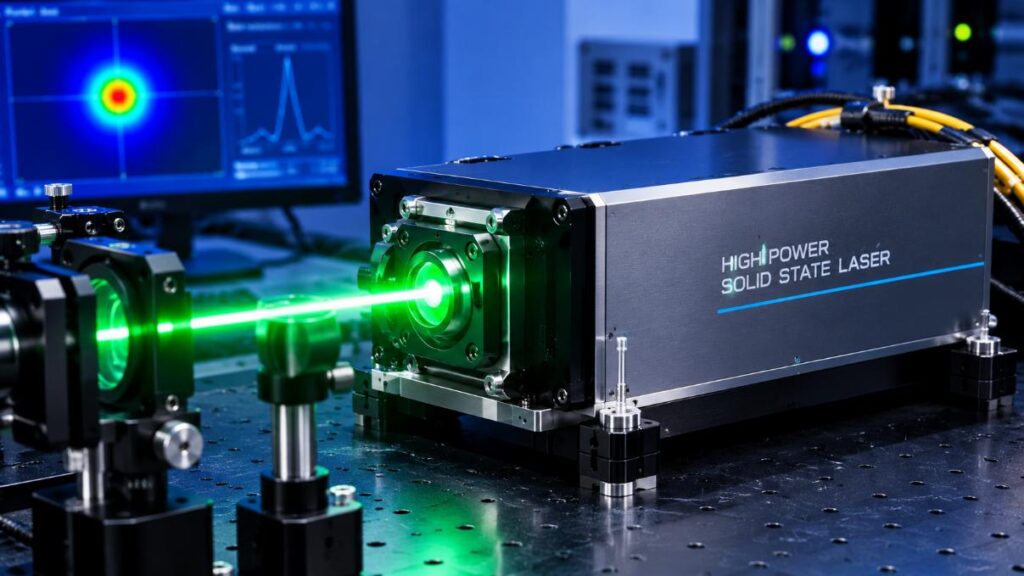
A solid state laser uses a solid gain medium. This medium is usually a crystal or glass doped with rare earth ions such as neodymium or ytterbium. Pump light excites those ions. The crystal stores that energy, then releases it as a clean, coherent beam.
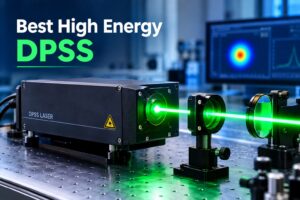
A high power solid state laser pushes this design to high average power or high pulse energy. Most modern versions use laser diodes as the pump source. Engineers call this design diode-pumped solid state, or DPSS. It replaced older flashlamp designs because diodes last longer and waste less heat.
Several features define the category:
- Energy storage: the crystal holds energy for hundreds of microseconds, which allows giant pulses through Q-switching.
- Excellent beam quality: the resonator shapes the beam into a near-perfect spot.
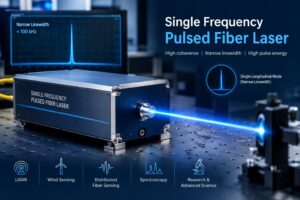
- Narrow linewidth options: single frequency designs deliver extremely pure light.
- Wavelength flexibility: nonlinear crystals convert infrared output into green and ultraviolet light.
These traits explain why labs, defense programs, and precision factories rely on solid state systems. Next, let’s look at the other side of the comparison.
What Is a Semiconductor Laser?
A semiconductor laser, also called a laser diode, generates light inside a tiny semiconductor junction. You drive it with electrical current. Electrons and holes recombine, and photons come out. No separate pump source is needed.
This direct conversion gives semiconductor lasers a strong list of advantages. They are small, often the size of a grain of rice. They are efficient, with wall-plug efficiency that can exceed 50%. They also cost little in volume. That is why billions of them sit inside phones, data centers, barcode scanners, and optical fiber networks.
The trade-off is physical. Carriers in a semiconductor recombine within nanoseconds. The material cannot store energy the way a crystal does. As a result, a diode laser cannot build up a giant pulse on its own. It also tends to produce a wider, less symmetrical beam. Those limits shape every comparison that follows.
High Power Solid State Laser vs Semiconductor Laser: The Key Differences
Both technologies produce coherent light. Beyond that, they diverge on almost every parameter engineers care about. Here are the differences that matter most.
1. Gain Medium and How Light Is Made
A solid state laser needs two steps. Pump light excites the crystal first. The crystal then emits the laser beam. A semiconductor laser needs one step. Current goes in, and light comes out. This single difference drives nearly every other contrast on this list. The two-step process adds complexity but unlocks energy storage and superb beam control.
2. Beam Quality and Brightness
Beam quality decides how tightly you can focus light. A DPSS laser typically delivers an M² value near 1. That means a near-ideal beam. A high power diode bar often has an M² of several hundred in one axis. For cutting fine features, scribing wafers, or ranging at long distances, beam quality wins. Solid state lasers hold a clear advantage here.
3. Pulse Energy and Peak Power
Energy storage is the solid state laser’s superpower. Nd:YAG holds its upper-state energy for roughly 230 microseconds. Q-switching releases that energy in a few nanoseconds. The result is millijoule to joule pulses with megawatt peak power. A semiconductor laser cannot match this. Its pulses stay short and weak by comparison. Applications such as LIBS, laser shock peening, and coherent LiDAR depend on high pulse energy.
4. Wavelength Reach and Ultraviolet Output
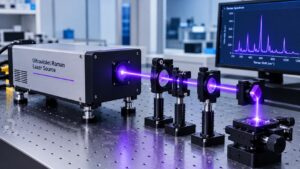
Semiconductor lasers emit at wavelengths set by their material. Gallium nitride devices reach blue and near-UV. Deep UV laser diodes remain difficult and rare. Solid state lasers take a different route. Nonlinear crystals convert the 1064 nm output into harmonics at 355 nm, 266 nm, or shorter. This is how an ultraviolet Raman laser source reaches the deep UV window. UV excitation boosts Raman signal strength and avoids fluorescence that ruins visible-light measurements. An all-solid-state UV laser also needs no gas tubes or consumables.
5. Linewidth and Frequency Stability
Precision science needs pure, stable light. Single frequency solid state lasers reach kilohertz linewidths with outstanding long-term stability. Standard diode lasers have wider linewidths, usually in the megahertz range. External-cavity diode designs narrow that gap, but they add cost and complexity. For metrology, an iodine-stabilized laser locks a solid state source to an atomic absorption line. A 3.5GHz frequency-shifted laser adds a precise offset for heterodyne detection and interferometry. Both tools build on the frequency purity that solid state platforms provide.
6. Efficiency, Size, and Cost
Here the semiconductor laser wins. Direct electrical-to-optical conversion gives higher efficiency and a much smaller package. Volume pricing is low. A solid state system uses more optics, more thermal management, and more assembly. It costs more per unit. However, the cost per useful joule or per usable watt in a tight spot often favors the solid state laser in demanding jobs.
7. Lifetime and Reliability
Both types last tens of thousands of hours when engineers design them well. Diode lasers can fail suddenly from facet damage or overdrive. DPSS lasers degrade more gradually, and most of their wear comes from the pump diodes. Replacing those diodes restores output without replacing the crystal. Ask any supplier for lifetime data under your real operating conditions.
What the Market Numbers Say in 2026
Both technologies keep growing. The stats show where demand sits today.
- Bulk solid-state lasers: Global Market Insights values the market at 2.3 billion US dollars in 2025 and 2.4 billion in 2026. It projects 5.2 billion by 2035, a CAGR of 8.7%.
- DPSS leads the pack: the same report shows diode-pumped systems as the largest segment, valued at 1.6 billion dollars in 2025.
- Semiconductor lasers: Precedence Research reports 9.74 billion dollars in 2025 and 10.67 billion in 2026. Other analysts land near 10.1 billion for 2026.
- Regional strength: the same report puts Asia Pacific at 50% of semiconductor laser revenue in 2025.
- Industrial pull: Fortune Business Insights expects materials processing to hold 37.03% of the semiconductor laser market in 2026.
Two lessons stand out. First, the semiconductor market is larger by volume. Second, DPSS technology dominates the premium bulk solid-state segment. These markets overlap more than they compete. Diode lasers pump many solid state lasers, so growth in one often feeds the other.
Where Each Laser Wins in Real Applications
Match the laser to the job. These examples show the pattern.
Best Uses for High Power Solid State Lasers
- Coherent LiDAR and wind sensing: narrow linewidth and high pulse energy make Doppler measurement possible.
- LIBS elemental analysis: short, powerful pulses create the plasma that reveals composition.
- Semiconductor and PCB processing: UV output cuts and drills with minimal heat damage.
- Scientific research: spectroscopy, nonlinear optics, and plasma physics demand pure, stable light.
- Defense and rangefinding: rugged pulsed lasers survive vibration and temperature swings.
Best Uses for Semiconductor Lasers
- Telecom and data centers: low-cost, fast-modulated light moves data across fiber.
- Pumping other lasers: diode arrays energize solid state and fiber lasers.
- Consumer electronics: sensors, facial recognition, and optical drives rely on tiny diodes.
- Direct-diode materials processing: brazing, cladding, and heat treatment tolerate lower beam quality.
- Medical devices: compact diode lasers support therapy and diagnostics.
Notice the pattern. Semiconductor lasers win on cost, size, and volume. Solid state lasers win on beam quality, pulse energy, and frequency purity. Many systems use both, which brings us to the next point.
How the Two Technologies Work Together
The debate is not always either-or. A DPSS laser is, by definition, a semiconductor laser pumping a solid crystal. The diode supplies cheap, efficient pump light. The crystal turns that light into a high-quality beam. Each technology does what it does best.
Fiber lasers follow the same logic. Diode pump modules feed a doped fiber, and the fiber produces a bright, narrow beam. Seed lasers often come from compact semiconductor sources. Amplifier chains then boost the signal. So when you evaluate a laser system, look at the whole chain. Ask which parts are semiconductor, which parts are solid state, and why the designer made each choice.
For general background on this architecture, the diode-pumped solid-state laser overview explains the physics clearly.
How to Choose Between Them
Use this simple checklist before you request quotes.
- Define the beam you need: if you must focus to a tiny spot or reach long range, pick solid state.
- Define the pulse you need: if your process needs millijoule or joule pulses, pick solid state.
- Check the wavelength: if you need deep UV or green output, pick a frequency-converted solid state laser.
- Check the linewidth: if your measurement needs kilohertz purity, pick a single frequency solid state source.
- Check the budget and size: if cost and compactness dominate, and beam quality can relax, pick a semiconductor laser.
- Check the support: choose a supplier who shares real test data and offers OEM engineering help.
Request measured numbers for pulse stability, beam quality, and linewidth. Datasheet claims alone prove little. A good supplier answers these questions quickly and with data.
Final Thoughts
Semiconductor lasers and solid state lasers are partners as much as rivals. Diodes bring efficiency, size, and low cost. Solid state crystals bring beam quality, energy storage, and frequency purity. Your application decides the winner. For precision sensing, spectroscopy, UV processing, and high pulse energy work, solid state technology leads.
Solid Laser builds its platforms around exactly these strengths. Its high power solid state laser lines serve LiDAR, spectroscopy, and OEM customers with stable pulse energy and narrow linewidth. Have a project in mind? Contact the Solid Laser team to discuss your specifications and get a recommendation that fits your application.