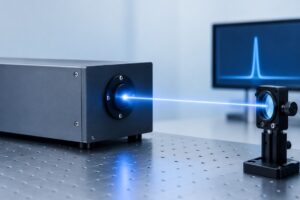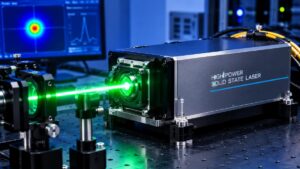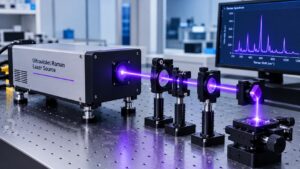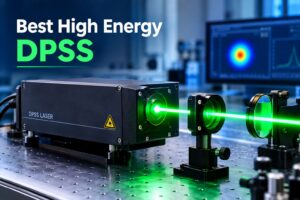
Modern laser technology has evolved rapidly, and one of the most advanced types today is the Single-Frequency Pulsed Fiber Laser. These lasers are widely used in scientific research, precision manufacturing, and communication systems because of their high stability and accuracy.
Unlike traditional lasers, they operate at a single frequency with pulsed output, which allows precise control over energy delivery. Fiber lasers use doped optical fibers to amplify light efficiently and produce high-quality beams.
Many systems also integrate technologies like doubled DPSS Lasers and High Energy DPSS laser sources for improved performance and amplification.
In this article, we will explain the working principles of Single-Frequency Pulsed Fiber Lasers, their components, and why they are important in modern applications.
What are Single-Frequency Pulsed Fiber Lasers?
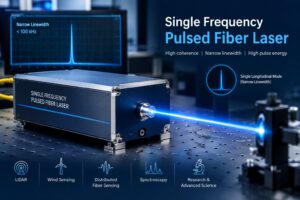
Single-Frequency Pulsed Fiber Lasers are laser systems that produce light at a single optical frequency while operating in pulsed mode. This means they emit light in short bursts instead of a continuous beam.
These lasers achieve single-frequency operation by limiting the resonator to one longitudinal mode, resulting in a very narrow linewidth and high coherence.
The pulsed nature allows better control over energy, making them ideal for precision tasks.
Compared to doubled DPSS Lasers, fiber lasers offer better stability and compact design. They are often used together in advanced systems to improve output power and efficiency.
Core Working Principle of Single-Frequency Pulsed Fiber Lasers
The working principle of Single-Frequency Pulsed Fiber Lasers is based on three main concepts: population inversion, stimulated emission, and resonator feedback.
- Population Inversion: The fiber core is doped with rare-earth elements like ytterbium or erbium. When pumped with diode lasers, these atoms get excited to higher energy levels.
- Stimulated Emission: When excited atoms return to a lower energy state, they emit photons. These photons stimulate other atoms to emit more photons, creating amplification.
- Optical Resonator: The laser cavity uses mirrors or fiber Bragg gratings to reflect light back and forth, ensuring amplification at a single frequency.
Pulse generation is achieved using techniques like Q-switching or mode-locking, which control how energy is released.
In some systems, High Energy DPSS laser sources are used as seed lasers to enhance performance.
Key Components of the System
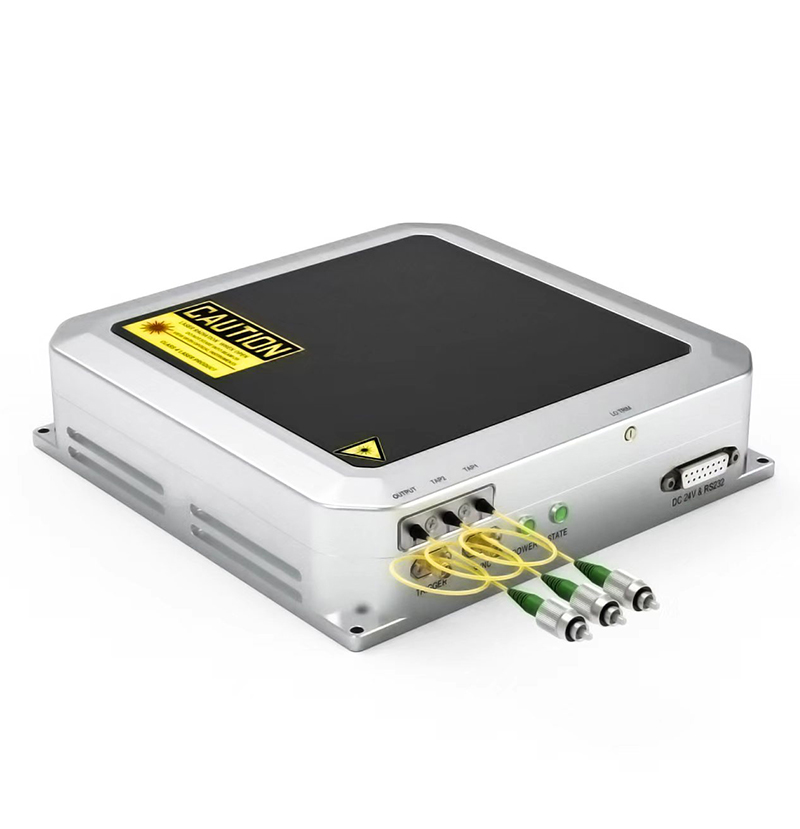
A typical Single-Frequency Pulsed Fiber Laser system includes several important components:
- Pump Source: Usually diode lasers that provide energy to excite the fiber
- Gain Medium: Rare-earth-doped optical fiber
- Resonator: Fiber Bragg gratings or ring cavity
- Modulators: Used for pulse generation
- Output Coupler: Releases the laser beam
The pump source plays a crucial role in efficiency. Fiber lasers are often preferred because they provide better heat management and stability compared to traditional lasers.
Advanced systems may combine fiber lasers with doubled DPSS Lasers to achieve specific wavelengths and higher output power.
Pulse Generation Techniques
Pulse generation is a key feature of Single-Frequency Pulsed Fiber Lasers. There are several methods used:
- Gain Switching: Rapid modulation of the pump source
- Q-Switching: Controls cavity losses to release energy in pulses
- Mode-Locking: Synchronizes multiple modes to create ultra-short pulses
Each method produces different pulse durations and energy levels. For example, Q-switching produces nanosecond pulses, while mode-locking can generate femtosecond pulses.
Compared to High Energy DPSS laser systems, fiber lasers offer better control over pulse shape and stability.
Advantages Over Traditional Laser Systems
Single-Frequency Pulsed Fiber Lasers offer several advantages:
- High beam quality
- Narrow linewidth
- Compact design
- Better heat dissipation
These features make them more efficient than traditional solid-state lasers. Fiber geometry ensures stable operation and reduces alignment issues.
While doubled DPSS Lasers are still used for specific applications, fiber lasers are becoming more popular due to their reliability and scalability.
Applications of Single-Frequency Pulsed Fiber Lasers
These lasers are widely used in many industries:
- Material Processing: Cutting, engraving, and welding
- Medical Applications: Surgery and imaging
- Communication: Optical fiber networks
- Scientific Research: Spectroscopy and sensing
Their ability to deliver high peak power and precise pulses makes them ideal for advanced applications.
In some applications, High Energy DPSS laser systems are combined with fiber lasers to achieve higher output energy and better performance.
Comparison with DPSS Lasers
Both fiber lasers and DPSS lasers are widely used, but they have differences.
Single-Frequency Pulsed Fiber Lasers offer:
- Better stability
- Compact design
- High efficiency
Doubled DPSS Lasers are known for:
- Suitability for specific wavelengths
- High peak energy
- More complex setup
Fiber lasers are generally more reliable and easier to maintain. However, High Energy DPSS laser systems are still preferred in applications requiring very high energy pulses.
Conclusion
Understanding the working principles of Single-Frequency Pulsed Fiber Lasers helps in choosing the right laser system for different applications. These lasers combine single-frequency operation with pulsed output, providing high precision and efficiency.
Their advantages, such as stability, compact design, and high beam quality, make them suitable for modern industries and research fields. While technologies like doubled DPSS Lasers and High Energy DPSS laser systems still play an important role, fiber lasers are becoming the preferred choice for many applications.
As laser technology continues to evolve, Single-Frequency Pulsed Fiber Lasers will play a key role in advancing scientific research, communication, and industrial processes.
FAQs About: Single-Frequency Pulsed Fiber Lasers