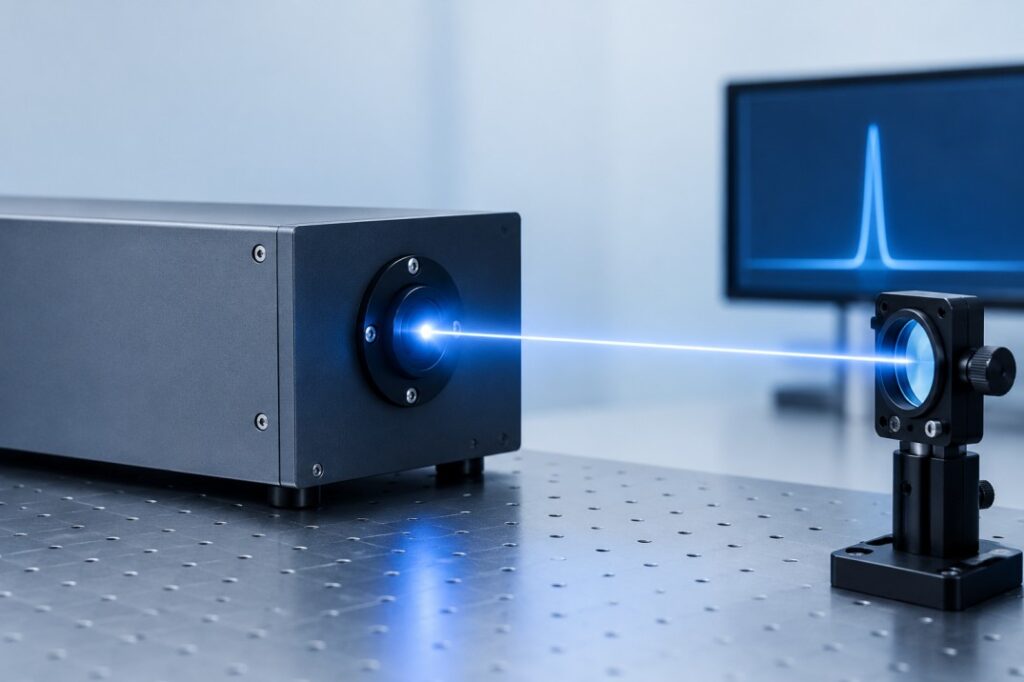
Speed changes what a laser can do. A sub-nanosecond pulsed laser squeezes its energy into a burst shorter than a billionth of a second. That burst hits a material with enormous peak power and leaves very little time for heat to spread. The result is cleaner cuts, sharper signals, and more precise measurements.
This guide explains how these lasers work in plain language. You will see why shorter pulses matter, which technologies produce them, and where they deliver the biggest gains. You will also find current market numbers, a comparison with picosecond and femtosecond sources, and a simple checklist for choosing a system. Let’s start with the basics.
What Is a Sub-Nanosecond Pulsed Laser?
A pulsed laser releases light in short bursts instead of a continuous beam. Pulse duration tells you how long each burst lasts. A sub-nanosecond pulsed laser produces bursts shorter than one nanosecond. That equals less than 1,000 picoseconds.
To picture the scale, think about light itself. Light travels about 30 centimeters in one nanosecond. A 500 picosecond pulse stretches only about 15 centimeters through space. Your eye cannot see it, but a sample feels every bit of it.
Engineers describe pulses with three numbers:
- Pulse energy: the total energy in one burst, usually measured in microjoules or millijoules.
- Pulse duration: how long that energy lasts, measured here in picoseconds.
- Peak power: pulse energy divided by pulse duration, which sets how hard the pulse hits.
Peak power is where shorter pulses shine. Take a 1 millijoule pulse. Stretch it over 5 nanoseconds, and you get 200 kilowatts of peak power. Compress the same energy into 500 picoseconds, and you get 2 megawatts. Same energy, ten times the punch. Now let’s see why that extra punch matters.
Why Shorter Pulses Deliver Ultra-Fast Precision
Short pulses improve precision in three clear ways. Each one solves a problem that longer pulses create.
1. Less Heat Spreads Into the Material
Heat needs time to travel. A long pulse keeps delivering energy while heat flows outward. That heat melts the edges of a cut, burns nearby material, and leaves a rough finish. A sub-nanosecond pulse ends before most of that heat escapes. The energy stays where you aimed it. You get smaller heat-affected zones and cleaner edges, especially on thin films, polymers, and delicate electronics.
2. Higher Peak Power Creates Stronger Interactions
Peak power drives ablation, plasma formation, and nonlinear effects. A higher peak power vaporizes material more efficiently. It also creates hotter, cleaner plasma for spectroscopy. This is why a LIBS Laser Source built around short pulses often detects trace elements better than a standard nanosecond design. The plasma forms faster and emits a stronger signal with less background noise.
3. Sharper Timing Improves Measurement Accuracy
Many measurements depend on timing. LiDAR and rangefinding systems, for example, calculate distance from the round trip of a pulse. Shorter pulses give finer range resolution. A 500 picosecond pulse resolves distance to roughly 7.5 centimeters, while a 5 nanosecond pulse resolves it to roughly 75 centimeters. Shorter pulses also help time-gated detection reject unwanted light. Precision starts with the pulse, and the next question is how a laser makes it.
How Modern Lasers Produce Sub-Nanosecond Pulses
Several technologies can create very short pulses. Compact solid-state designs dominate the sub-nanosecond range because they combine short pulses with real pulse energy.
Passive Q-Switching in Microchip Cavities
Most sub-nanosecond sources use a trick called Q-switching. The laser crystal stores pump energy while a switch keeps the cavity closed. When stored energy reaches a threshold, the switch opens and releases everything at once. A passive Q-switch uses a saturable absorber crystal for this job. It needs no external driver electronics.
Make the cavity very short, and the pulse gets very short too. A microchip laser uses a cavity only a few millimeters long. That tiny length produces pulses in the hundreds of picoseconds. The design is simple, rugged, and stable. It also fits into handheld instruments.
Diode Pumping Makes It Practical
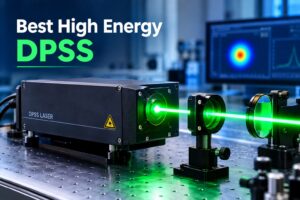
Laser diodes supply the pump light for these cavities. Engineers call the result a diode-pumped solid state, or DPSS, laser. Diodes last longer than the old flashlamps. They waste less heat. They also let designers build smaller, lighter, and more efficient modules. Today’s Diode-Pumped High Energy Lasers deliver millijoule-level pulses from packages small enough to hold in one hand.
A well-built short-pulse DPSS laser keeps pulse energy steady from shot to shot, often within a few percent. That stability matters because spectroscopy and micromachining both depend on repeatable pulses. If you want a deeper look at the physics, the ultrashort pulse overview covers pulse generation in detail.
Where Compact DPSS Designs Fit
Many buyers want short pulses without a large, expensive system. That is where compact DPSS lasers earn their place. They deliver stable, repeatable pulses in a small footprint. Instrument builders can mount them inside analyzers, rangefinders, and marking tools. Next, let’s look at where this technology creates the most value.
Where Sub-Nanosecond Lasers Deliver the Most Value
These lasers sit in a sweet spot. They offer higher peak power than standard nanosecond sources, yet they cost far less than femtosecond systems. That balance explains their growth across several industries.
- LIBS elemental analysis: short pulses create hotter plasma and cleaner spectra for mining, recycling, and metallurgy.
- Micromachining and marking: clean ablation marks metals, plastics, and ceramics without burning the surrounding area.
- Raman spectroscopy: stable pulses, often converted to ultraviolet, drive sensitive chemical analysis.
- LiDAR and rangefinding: fine range resolution helps compact sensors see small distance differences.
- Photoacoustic and nonlinear imaging: short pulses generate strong signals in tissue and biological samples.
- Microfluidics and thin-film processing: low heat damage protects fragile structures.
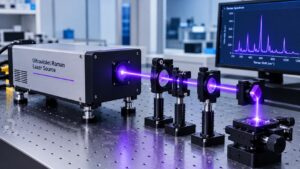
Take Raman work as an example. Many research teams pair a short-pulse source with harmonic conversion to reach deep UV light. UV excitation boosts Raman signal strength and avoids fluorescence. Our guide to the top ultraviolet Raman laser sources compares the leading options if you work in that area.
A Closer Look at LIBS
LIBS shows the benefit of short pulses clearly. The laser fires at a sample and creates a tiny plasma. A spectrometer reads the light from that plasma and identifies every element. A short pulse couples energy into the surface quickly, which improves repeatability on rough, uncleaned samples. Field teams get faster answers with less sample preparation. That is why handheld analyzers rely so heavily on compact, passively Q-switched sources.
What the Market Numbers Say in 2026
Demand for fast pulsed lasers keeps climbing. The numbers show how strong that momentum is.
- Market size: Fortune Business Insights values the global ultrafast laser market at 2.57 billion US dollars in 2025.
- 2026 outlook: the same report projects 2.99 billion dollars in 2026.
- Long-term forecast: it expects 10.26 billion dollars by 2034, a CAGR of 16.62%.
- Industry trend: buyers increasingly want turnkey solutions that combine laser sources, optics, and software.
- Main brake on growth: cost still slows adoption in price-sensitive markets.
That last point matters for your decision. Femtosecond systems cost the most. Sub-nanosecond DPSS sources give many users 80% of the benefit at a much lower price. Buyers who need speed without a giant budget increasingly choose them.
Sub-Nanosecond vs Picosecond vs Femtosecond Lasers
Pulse duration is not a simple ranking. Each range fits different jobs. Here is how the main options compare.
Nanosecond DPSS Lasers: The Workhorse
A nanosecond DPSS laser produces pulses from about 1 to 10 nanoseconds. It offers high pulse energy, low cost, and proven reliability. It works well for general marking, standard LIBS, and rangefinding. The trade-off is more heat spread and lower peak power.
Sub-Nanosecond and Picosecond Sources
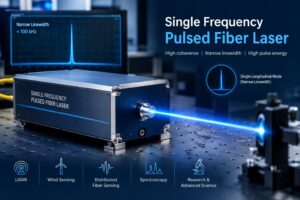
Sub-nanosecond lasers bridge the gap. They give you stronger peak power and cleaner interactions without extreme cost. A picosecond fiber laser goes further. It offers pulses in the single-digit to hundreds of picoseconds, with high repetition rates and excellent beam quality. Fiber sources suit high-throughput processing and seeding applications. If you want to explore that world, read our list of the top single frequency pulsed fiber lasers.
Femtosecond Lasers: Maximum Precision
A femtosecond fiber laser delivers pulses below one picosecond. Heat has almost no time to spread, so these lasers cut glass, tissue, and thin films with extreme finesse. They also cost the most and need more complex systems. Choose femtosecond pulses when your application truly needs that level of cold ablation. Otherwise, a sub-nanosecond source often solves the problem for less money.
How to Choose the Right Pulsed Laser
Work through this checklist before you request quotes.
- Pulse duration: match it to your material. Heat-sensitive samples benefit from shorter pulses, while robust metals tolerate longer ones.
- Pulse energy: most LIBS and marking work needs about 1 to 50 millijoules. Delicate samples need less.
- Repetition rate: higher rates speed up mapping and averaging. Lower rates suit high-energy single shots.
- Beam quality: a clean beam focuses to a tiny spot. Ask for measured M² values.
- Stability: request pulse-to-pulse data. Under 3% RMS supports quantitative work well.
- Integration support: OEM builders need compact modules and responsive engineering help.
Stability deserves extra attention. Drift in frequency or energy ruins measurements, and frequency-sensitive systems suffer most. If you work on precision metrology, our article on iodine-stabilized laser frequency drift solutions explains practical fixes. Strong suppliers also share real test data instead of marketing claims. Treat that openness as part of your evaluation.
Finally, think about the whole system. A complete DPSS laser system should include the laser head, driver, and cooling that match your duty cycle. A great laser head in a weak system still underperforms.
Final Thoughts
A sub-nanosecond pulsed laser delivers ultra-fast precision by packing energy into extremely short bursts. Higher peak power, lower heat damage, and sharper timing combine into cleaner results across LIBS, micromachining, Raman, and ranging. Compact diode-pumped designs now make this performance practical outside the lab.
Solid Laser designs its platforms around exactly these strengths. The company builds stable, compact pulsed sources and supports OEM customers from prototype through production. Define your pulse duration, energy, and integration needs first. Then choose a partner who backs every specification with measured data.
FAQs About: Sub-Nanosecond Pulsed Laser
1. What is a sub-nanosecond pulsed laser?
2. How is a sub-nanosecond laser different from a nanosecond DPSS laser?
3. When should I choose a picosecond or femtosecond fiber laser instead?
4. Can I use a sub-nanosecond pulsed laser as a LIBS laser source?
5. What are compact DPSS lasers used for?
6. What should I check before buying a DPSS laser system?