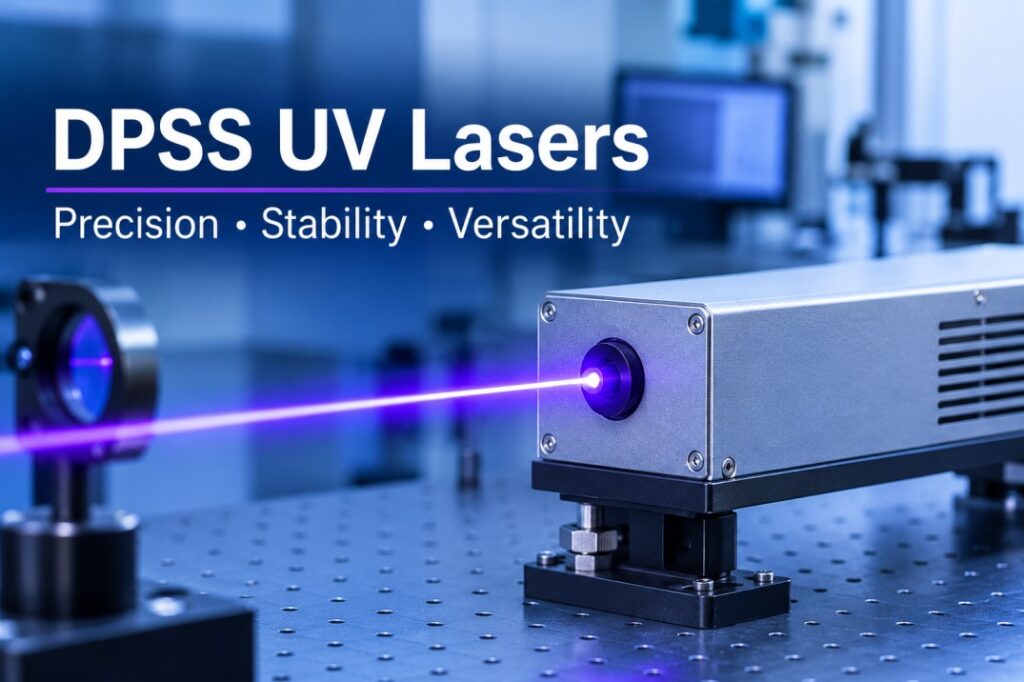
Ultraviolet light lets a laser do delicate work that infrared light cannot. DPSS UV lasers turn a compact infrared crystal laser into a short-wavelength tool for marking, micromachining, inspection, and spectroscopy. They focus to tiny spots, couple strongly into many materials, and spread very little heat. That combination explains why electronics, medical, and research teams keep adopting them.
This guide explains how these lasers work in plain language. You will see why UV wavelengths improve precision, where industries use them, and what the latest market numbers show. You will also find a simple checklist for choosing a source and a look at how UV lasers compare with picosecond and femtosecond options. Let’s start with the basics.
What Are DPSS UV Lasers?
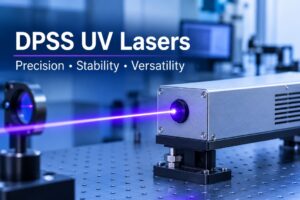
DPSS stands for diode-pumped solid state. A laser diode pumps a crystal, usually Nd:YAG or Nd:YVO4. The crystal emits infrared light at 1064 nm. That wavelength sits far from the UV range, so the laser needs one more step.
Nonlinear crystals perform that step. They combine photons to create harmonics. Each harmonic cuts the wavelength by a fixed fraction:
- Second harmonic: 532 nm green light.
- Third harmonic: 355 nm near-UV light, the most common industrial choice.
- Fourth harmonic: 266 nm deep UV light for fine work and spectroscopy.
- Fifth harmonic: 213 nm for specialized research.
The whole process happens inside a sealed module. You plug in power and receive a stable UV beam. No gas tubes, no liquid dyes, and no regular refills. That simplicity makes solid-state UV sources popular on production lines and in handheld instruments.
Why UV Wavelengths Deliver High Precision
Wavelength shapes almost everything a laser does to a material. Shorter wavelengths bring three clear advantages.
1. Smaller Focus Spots
A lens cannot focus light to a spot smaller than the wavelength allows. The minimum spot size scales with wavelength. A 355 nm beam focuses to a spot roughly three times smaller than a 1064 nm beam, assuming the same optics and beam quality. Smaller spots mean finer lines, tighter holes, and higher resolution. Engineers who need features measured in micrometers choose UV for exactly this reason.
2. Stronger Absorption
Many materials reflect or transmit infrared light but absorb UV light well. Copper reflects most 1064 nm light and absorbs far more at 355 nm. Glass, ceramics, and many polymers behave in a similar way. Better absorption means the laser needs less pulse energy to do the same job. It also means cleaner, more repeatable results.
3. Cold Processing With Less Heat
A single UV photon carries a lot of energy. At 355 nm, each photon holds about 3.5 electron volts. That figure comes close to the bond energy of many carbon-carbon bonds in polymers, roughly 3.6 electron volts. UV photons can break those bonds directly instead of heating the material until it melts. Engineers call this photochemical ablation, or cold processing. The edges stay sharp, and the surrounding area stays intact.
These three advantages explain the demand. Next, let’s look at where factories and labs put them to work.
Top Industrial Uses of DPSS UV Lasers
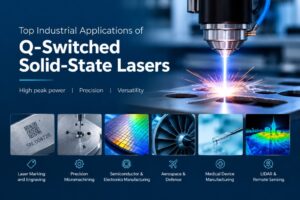
UV lasers now support a wide range of industries. These applications lead the list.
Electronics and PCB Processing
Modern circuit boards pack more features into less space. UV lasers cut flexible printed circuits, drill microvias, and trim thin films without charring the edges. Manufacturers also scribe ceramic substrates and separate delicate boards without mechanical stress. The tiny spot size and low heat protect nearby components, which raises yield on high-density designs.
Marking Glass, Plastics, and Medical Devices
Infrared lasers struggle to mark clear materials. UV light marks glass, transparent plastics, and sensitive polymers with sharp contrast. Medical device makers rely on it to add permanent codes to syringes, catheters, and implants. These marks carry traceability data and survive sterilization. The low heat input avoids cracking and discoloration.
Semiconductor and Display Manufacturing
Chipmakers and display producers need precise, clean processing at tiny scales. UV DPSS lasers support wafer inspection, dicing, repair, and annealing steps. According to Laser Focus World, DPSS lasers at UV and deep-UV wavelengths are growing much faster than 10% a year. Better precision in semiconductor inspection drives much of that growth.
Spectroscopy and Chemical Analysis
UV light excites Raman scattering more strongly and avoids fluorescence that blurs visible-light measurements. Pharmaceutical labs verify drug identity this way. Environmental teams screen water and soil for trace contaminants. Our guide to the top ultraviolet Raman laser sources compares the leading options for this work.
Metrology and Scientific Research
Researchers use UV sources to pump other lasers, drive nonlinear experiments, and probe atomic transitions. Many setups seed a UV conversion chain with a stable, narrow-linewidth source. Frequency drift ruins that stability, so labs work hard to control it. Our article on iodine-stabilized laser frequency drift solutions explains practical fixes. You can also compare seed sources in our list of the top single frequency pulsed fiber lasers.
What the Market Numbers Say in 2026
Demand for UV solid-state lasers keeps rising. The numbers back that up.
- Market size: WiseGuy Reports values the global UV DPSS laser market at 846.3 million US dollars in 2025.
- Long-term forecast: the same report projects 1.5 billion dollars by 2035, a CAGR of 5.9%.
- Demand drivers: the report points to medical, semiconductor, and telecommunications uses.
- Short-wavelength growth: Laser Focus World reports that UV and deep-UV DPSS sales grow much faster than 10% a year.
Different analysts publish different totals, because each firm defines the UV laser market in its own way. The direction matches across reports, though. Demand grows steadily, and UV solid-state sources lead that growth. Buyers who invest now join a healthy, expanding market.
Key Specifications That Shape UV Laser Performance
Two UV lasers can look alike on paper and perform very differently. Five specifications deserve your attention.
Pulse Energy and Repetition Rate
Pulse energy sets how much material each shot removes. Repetition rate sets how many shots you fire per second. Together they decide your throughput. A high repetition rate DPSS laser fires thousands to hundreds of thousands of pulses per second. That speed produces smooth lines, fast scribing, and quick mapping. Each pulse carries less energy at high rates, so many users pair the two settings with care.
A High repetition DPSS laser also suits marking and inspection tasks that need continuous-looking output. Choose a lower rate with higher pulse energy for deep ablation or single-shot work.
Pulse Stability and Beam Quality
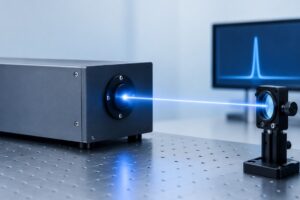
Stable pulses give repeatable results. Look for pulse-to-pulse variation under 3% RMS. Beam quality matters just as much. A clean beam, with an M² near 1, focuses to the smallest possible spot. Ask suppliers for measured data, not just datasheet claims.
Lifetime and UV Optics Durability
UV light stresses optics and crystals more than visible light does. Coatings degrade, and crystals can darken over time. Quality designs use sealed cavities, controlled temperatures, and crystal shifting to extend life. Ask every supplier about service intervals and replacement costs. These numbers shape your true cost of ownership.
DPSS UV Lasers vs Picosecond and Femtosecond Fiber Lasers
UV wavelength is only one way to improve precision. Pulse duration is another. Many buyers compare both options, so here is a quick guide.
Nanosecond UV Lasers: Value and Versatility
A nanosecond DPSS UV laser costs less and offers high pulse energy. It handles marking, scribing, and most PCB work well. Cold UV photochemistry already reduces heat damage, so many users never need anything faster.
When Ultrafast Fiber Lasers Make Sense
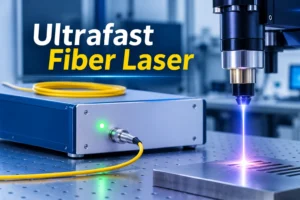
Some jobs demand even less heat. A picosecond fiber laser delivers pulses a thousand times shorter than a nanosecond. A femtosecond fiber laser goes shorter still. These sources suit glass cutting, thin-film structuring, and biological tissue work, where heat control matters most. They also cost more and add system complexity.
A simple rule helps. Start with a UV DPSS laser if your material absorbs UV well and your budget matters. Move to an ultrafast source only if heat damage still limits your results. Many teams also combine both, using UV for marking and ultrafast pulses for the hardest cuts.
How to Choose the Right UV Laser
Work through this checklist before you request quotes.
- Wavelength: 355 nm fits most industrial work. Choose 266 nm for finer detail, Raman work, or very sensitive materials.
- Pulse energy: match it to your material. Delicate films need microjoules, while thick ceramics need more.
- Repetition rate: higher rates speed up scribing and mapping. Lower rates suit deep ablation.
- Beam quality: request measured M² values at full power.
- Stability: ask for pulse-to-pulse data under your operating conditions.
- Size and cooling: check the footprint, power needs, and cooling method against your machine.
- Integration support: OEM builders need clear interface documentation and responsive engineering help.
Do not stop at price. A cheap laser that drifts or loses power early costs more in downtime and scrap. A good supplier shares real test data and asks about your application first. Treat that conversation as part of your evaluation.
Final Thoughts
DPSS UV lasers bring tight focus, strong absorption, and cold processing into compact, reliable modules. They mark glass, cut flexible circuits, support semiconductor steps, and drive sensitive spectroscopy. Choose your wavelength, pulse energy, and repetition rate to fit the job, and you gain precision without needless cost.
Solid Laser builds solid-state laser platforms around these strengths. The company supports OEM customers from prototype through production. Define your wavelength, pulse parameters, and integration needs first. Then choose a partner who backs every specification with measured data.