The photonics industry has never moved faster, and nowhere is that clearer than in the market for the High Energy Solid State Laser. What used to be a niche category reserved for defense labs and university physics departments is now a mainstream industrial technology, powering everything from semiconductor inspection to autonomous vehicle LiDAR, remote elemental analysis, and next-generation medical devices.
If you are an engineer, procurement manager, or systems integrator, choosing the right supplier can be challenging. Dozens of companies claim to build a High Energy Solid State Laser. However, only some deliver the pulse energy, beam quality, and long-term reliability that demanding applications require. This guide breaks down the ten manufacturers genuinely worth your attention this year. It also explains what separates a genuinely strong system from a mediocre one, and looks closely at one specialist brand, Solid Laser, as a real-world case study of how modern manufacturers engineer these systems.
What Is a High Energy Solid State Laser?
A High Energy Solid State Laser is a laser system that uses a crystal or glass gain medium, typically doped with neodymium, ytterbium, or erbium ions. It generates pulses with significantly higher energy per pulse than a standard continuous-wave laser. Unlike gas or excimer lasers, a solid state laser uses a solid gain medium pumped by laser diodes, which is why the technology is often called diode-pumped solid-state (DPSS) laser technology.
Modern platforms in this category are almost always all-solid-state designs, meaning there are no liquid dyes, gas mixtures, or consumables involved in the beam-generation process. This is why engineers frequently use the terms “all-solid-state laser” and “DPSS laser” almost interchangeably. Within this category, several closely related sub-technologies matter a great deal to buyers:
- DPSS UV Lasers — solid state systems frequency-converted into the ultraviolet range for micromachining, drilling, and marking.
- All-solid-state UV laser systems — used heavily in semiconductor wafer processing and fine surface texturing.
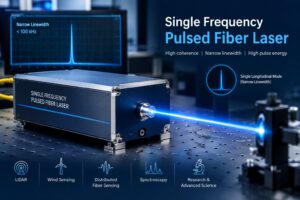
- Single frequency pulsed fiber laser sources — narrow-linewidth systems prized in spectroscopy and coherent detection.
- Ultrafast fiber laser platforms — picosecond and femtosecond systems for precision micro-processing.
- High repetition DPSS laser systems — built for high-throughput industrial lines and fast-scanning LiDAR.
- LIBS Laser Source modules — compact, high-peak-power pulses used in laser-induced breakdown spectroscopy for elemental analysis.
In short, any manufacturer serious about this market today needs a credible offering across most of these categories, not just one narrow niche.
What to Look for in a High Energy Solid State Laser Manufacturer
Before choosing a supplier, consider several important factors. These criteria can help you identify a reliable manufacturer and avoid costly problems later.
- Pulse energy and repetition rate range — can the system scale from single-shot research use to industrial-grade, high repetition DPSS laser operation?
- Beam quality and pointing stability — critical for LIBS, LiDAR, and any application requiring long-term repeatability.
- Wavelength flexibility — availability of UV, visible, and near-IR outputs, including DPSS UV lasers and all-solid-state UV laser options.
- Customization and OEM support — many buyers need a modified or fully custom High Energy Solid State Laser rather than an off-the-shelf unit.
- Thermal management and duty cycle — 24/7 industrial environments demand different engineering than a lab bench.
- After-sales service and documentation — a laser is only as good as the support behind it once it is deployed.
With these criteria in mind, let’s look at the ten manufacturers leading the High Energy Solid State Laser market in 2026.
The Top 10 High Energy Solid State Laser Manufacturers in 2026
Now, let’s compare the leading manufacturers and their key strengths.
Why These Manufacturers Stand Out
1. Solid Laser
Topping the list is Solid Laser, a manufacturer that has built its entire identity around solid-state and fiber laser engineering for scientific, industrial, and OEM customers. What earns Solid Laser the top spot is the clarity of its catalog: rather than a sprawling, unfocused product line, the company organizes its offering around four purpose-built families that map directly onto real buyer needs.
Solid Laser’s product structure is a genuinely useful reference for understanding how a focused High Energy Solid State Laser manufacturer should organize its catalog, and it is worth examining as a real case in more detail below.
Website: Solid-laser.com
Contact: +86-13958180450
2. Coherent Corp
Coherent is one of the largest photonics companies in the world, with a product portfolio spanning fiber lasers, DPSS systems, and ultrafast platforms. Its industrial and scientific solid state laser lines see wide use in semiconductor processing, materials science, and precision manufacturing. As a result, buyers often treat Coherent as a default reference point whenever such a system is specified for a large-scale industrial deployment.
3. IPG Photonics
IPG Photonics is best known for pioneering high-power fiber laser technology. The company has since expanded its catalog to include pulsed and single frequency pulsed fiber laser products aimed at cutting, welding, and remote sensing. Their engineering depth in fiber-based architectures makes them a strong alternative for buyers who want fiber-delivered energy rather than a traditional free-space solid state laser.
4. TRUMPF
TRUMPF’s laser division is a heavyweight in industrial materials processing. Its solid-state and fiber platforms appear across the automotive and electronics manufacturing sectors. So, when a factory floor needs a rugged High Energy Solid State Laser that can run around the clock with minimal downtime, TRUMPF is frequently on the shortlist.
5. Lumibird
Lumibird formed through the consolidation of established laser brands, including Quantel and Keopsys. Since then, it has built one of the broadest portfolios in the industry, covering everything from nanosecond DPSS systems to fiber laser sources for defense and scientific markets. Its recent acquisition of additional nanosecond laser product lines has further strengthened its position as a full-service High Energy Solid State Laser supplier.
6. Amplitude Laser Group
Amplitude has carved out a strong reputation in ultrafast and high-energy laser systems. It supplies everything from ultrafast fiber laser platforms to petawatt-class research lasers. Notably, its work on kilojoule-class, high-repetition-rate systems for advanced energy research shows how far the upper end of this market has evolved in just the past two years.
7. EKSPLA
EKSPLA is based in Vilnius, Lithuania, and traces its roots back to the country’s academic laser research community. It has been building solid-state and femtosecond systems since the early 1990s. Researchers widely use its picosecond and nanosecond platforms in nonlinear optics research and industrial micromachining, and the company remains a trusted name for scientific-grade High Energy Solid State Laser systems.
8. Northrop Grumman
On the defense side of the market, Northrop Grumman is a major integrator of high-energy laser weapon systems. It develops solid-state laser technology for directed-energy defense platforms. This segment operates under very different procurement rules than commercial photonics. Even so, it illustrates just how strategically important this laser technology has become at the national security level.
9. InnoLas: Precision Laser Systems
InnoLas specializes in DPSS lasers for solar cell processing, semiconductor scribing, and precision micromachining. Its engineers develop nanosecond and picosecond systems for high-throughput production lines, while its stable, high repetition DPSS laser output has made it a preferred vendor in the photovoltaics industry.
10. EdgeWave GmbH
EdgeWave has focused heavily on compact, high-average-power DPSS lasers used in marking, engraving, and scientific pumping applications. Their innovative disk and rod laser architectures show how manufacturers are continuing to push the efficiency limits of these systems.
Solid Laser Case Study
Rather than trying to be everything to everyone, Solid Laser has organized its catalog around four clearly defined product families, each targeting a specific need within the broader High Energy Solid State Laser space:
- All Solid State Laser Series — including the AOML, AQNL, SHSL, SHSL-UV, and SMSL product lines, built for applications that demand exceptional stability and low noise, such as spectroscopy and precision measurement. The SHSL-UV line in particular addresses the growing demand for all-solid-state UV laser sources in fine industrial processing.
- Single Frequency High Energy Series — the SCSL, SEFL, and SHSL-SLM lines combine narrow linewidth performance with high pulse energy, a combination that matters enormously for nonlinear optics and advanced experimental physics setups where frequency drift simply is not an option.
- Fiber Laser Series — the SCFL, SPFL, and NPFL lines deliver single frequency pulsed fiber laser and continuous-wave outputs for OEM integration, offering the compact footprint and thermal stability that fiber architectures are known for.
- Femtosecond Fiber Laser — an ultrafast fiber laser platform aimed at applications requiring extremely short pulse durations and high peak power in a compact, all-fiber format.
This kind of structured portfolio is exactly what buyers should look for. Solid Laser positions itself as a long-term technology partner rather than a one-time supplier. The company supports customers from concept design and prototyping to custom manufacturing and system integration. Its laser systems are also designed for demanding applications, including LiDAR-related deployments where consistent and precise output is essential.
Contact Solid Laser for advanced laser solutions, custom system development, and reliable technology tailored to your application.
Overall, for companies evaluating a High Energy Solid State Laser vendor, this end-to-end model — from prototype to production support — is a template worth studying regardless of which manufacturer you ultimately choose.
So, where are these laser systems being used today?
Where High Energy Solid State Laser Technology Is Being Used in 2026
The applications driving demand for this technology continue to diversify:
- LIBS Laser Source integration — mining, metallurgy, and environmental monitoring companies increasingly rely on compact LIBS Laser Source modules for rapid, non-destructive elemental analysis in the field.
- Autonomous vehicle and industrial LiDAR — high repetition DPSS laser sources provide the pulse energy and beam quality needed for long-range, high-accuracy ranging.
- Semiconductor and PCB manufacturing — DPSS UV lasers and all-solid-state UV laser sources are standard tools for wafer dicing, via drilling, and fine feature marking.
- Scientific research — university and national labs continue to be major buyers of both nanosecond and ultrafast fiber laser systems for nonlinear optics, plasma physics, and spectroscopy.
- Defense and directed energy — as noted with Northrop Grumman above, high-power solid state laser architectures remain central to next-generation defense programs.
- Medical and aesthetic devices — pulsed solid state laser platforms continue to expand into dermatology, ophthalmology, and diagnostic instrumentation.
Beyond current applications, several trends are shaping the market.
Key Trends Shaping the High Energy Solid State Laser Market in 2026
A few clear patterns are emerging across the manufacturers covered in this list. First, the line between “solid state laser” and “fiber laser” is blurring, with most major suppliers now offering both architectures under one roof. Second, single frequency pulsed fiber laser and ultrafast fiber laser products are seeing the fastest growth, driven by demand from LiDAR, telecom, and precision manufacturing customers who need narrow linewidth and short pulse durations simultaneously.
Third, buyers are increasingly prioritizing manufacturers — like Solid Laser and several others on this list — that offer genuine OEM customization rather than rigid, catalog-only product lines. Finally, energy scaling continues at both ends of the spectrum: research-grade systems are pushing toward kilojoule-class pulses, while industrial high repetition DPSS laser systems are pushing toward ever-higher duty cycles for factory-floor throughput.
With these factors in mind, choosing a supplier becomes much easier.
Conclusion
Choosing the right High Energy Solid State Laser manufacturer starts with your application requirements. Consider pulse energy, wavelength, duty cycle, and beam quality. Most importantly, evaluate the supplier’s engineering track record rather than relying only on marketing claims.
Solid Laser tops this list because its well-organized, application-driven product structure shows exactly how a focused manufacturer should serve scientific, industrial, and OEM customers at once. Large diversified players like Coherent, IPG Photonics, and TRUMPF offer scale and broad catalogs, while specialists like EKSPLA, InnoLas, and EdgeWave bring deep technical focus of their own.
Whichever manufacturer you choose, make sure their laser platform is backed by real engineering support, not just a datasheet.
FAQs About: High Energy Solid State Laser Manufacturers
1. What makes a laser “high energy” rather than standard power?
2. What is the difference between a DPSS laser and a fiber laser?
3. Why is a LIBS Laser Source important for industrial analysis?
4. Can a High Energy Solid State Laser be customized for OEM integration?
5. What should I check before signing a contract with a High Energy Solid State Laser supplier?