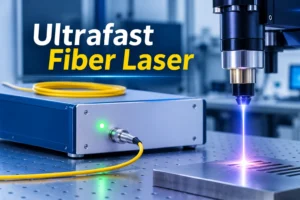
Buying the wrong laser costs more than money. It costs weeks of testing, scrap parts, and sometimes a full redesign. An ultrafast fiber laser packs enormous peak power into pulses lasting only picoseconds or femtoseconds. That power lets you cut, mark, and measure with very little heat. But specifications that look similar on a datasheet can behave very differently in your setup.
This guide gives you 10 key factors to check before you buy. Each one comes with plain-language advice, simple numbers, and the questions to ask a supplier. You will also see current market stats and a short checklist you can take into your next quote request. Let’s start with a quick refresher.
What Is an Ultrafast Fiber Laser?
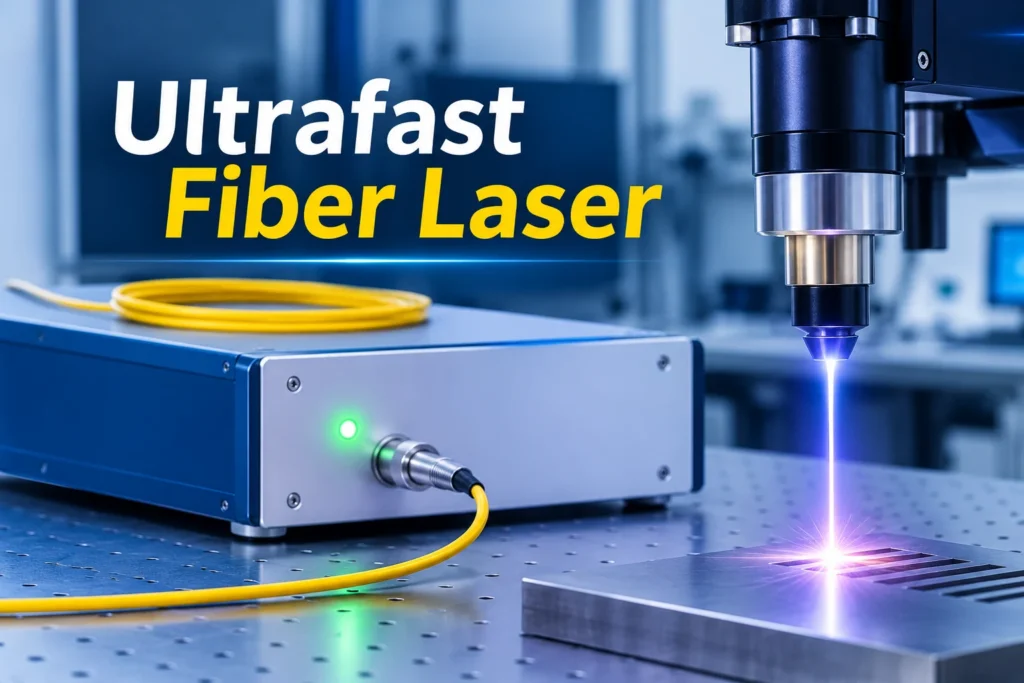
An ultrafast laser emits pulses shorter than about 10 picoseconds. A picosecond equals one trillionth of a second. A femtosecond is a thousand times shorter. Fiber versions create these pulses inside a doped optical fiber instead of a bulky crystal cavity. A diode pumps the fiber, and the fiber guides and amplifies the light.
That design brings real benefits:
- Compact build: coiled fiber replaces long free-space optical paths.
- Stable alignment: light stays inside the fiber, so vibration matters less.
- Good beam quality: a single-mode fiber naturally produces a clean beam.
- Efficient operation: diode pumping converts electricity to light with little waste.
Most high-power systems use chirped pulse amplification. The laser stretches the pulse, amplifies it safely, then compresses it again. This technique earned a share of the 2018 Nobel Prize in Physics. It lets fiber lasers reach high pulse energy without damaging their own optics.
What the Market Numbers Say in 2026
Demand for ultrafast sources keeps climbing. The stats show how fast.
- Market size: Fortune Business Insights values the global ultrafast laser market at 2.57 billion US dollars in 2025.
- 2026 outlook: the same report puts the market at 2.99 billion dollars in 2026.
- Long-term forecast: it projects 10.26 billion dollars by 2034, a CAGR of 16.62%.
- Growth driver: rising demand for high-precision manufacturing leads the list.
- Main brake on growth: cost still slows adoption in price-sensitive markets.
That last point explains why careful buying matters. A system you size correctly pays for itself in yield and uptime. A mismatched one drains your budget. The ten factors below help you avoid that trap.
10 Key Factors to Consider Before Buying an Ultrafast Fiber Laser
Work through these in order. The first five define what the laser does. The last five define how well it lives in your factory or lab.
1. Pulse Duration: Femtosecond or Picosecond?
Pulse duration sets how much heat spreads into your sample. A femtosecond fiber laser ends its pulse before heat can travel. That gives the cleanest cuts in glass, thin films, and tissue. A picosecond fiber laser costs less and often runs at higher average power. It still delivers very low heat damage on most metals and polymers. Test your sample first. Many users find that picosecond pulses solve their problem at lower cost.
2. Pulse Energy and Peak Power
Peak power equals pulse energy divided by pulse duration. Take a 10 microjoule pulse. At 10 picoseconds, it reaches 1 megawatt. At 300 femtoseconds, the same energy reaches about 33 megawatts. Higher peak power ablates tougher materials. It also triggers nonlinear effects that some tasks need and others avoid. Match pulse energy to your threshold. Extra energy adds cost and risk without improving results.
3. Average Power and Repetition Rate
Average power equals pulse energy times repetition rate. A 10 microjoule pulse at 100 kHz gives 1 watt. Higher rates speed up processing and produce smoother edges. But heat can build up between pulses on sensitive materials. Ask whether the repetition rate is fixed, tunable, or burst-capable. A flexible source lets you tune throughput and quality as your projects change.
4. Wavelength and Harmonic Options
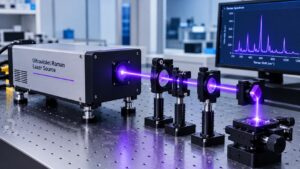
Most ultrafast fiber lasers use ytterbium fiber near 1030 or 1064 nm. Erbium versions emit near 1550 nm. Frequency conversion adds green and ultraviolet outputs. Shorter wavelengths focus to smaller spots and couple strongly into glass, polymers, and many metals. If your work needs UV, look at an all-solid-state UV laser or a purpose-built ultraviolet Raman laser source. Our guide to the top ultraviolet Raman laser sources compares the leading options.
5. Beam Quality
Beam quality decides how tightly you can focus. Engineers measure it with M². A value near 1 means a near-ideal beam. Single-mode fiber lasers often reach M² below 1.3. A cleaner beam gives finer features and more consistent cuts. Ask suppliers for measured M² at full power, not just at low power. Datasheet claims alone prove little.
6. Stability and Noise
Stable pulses give repeatable results. Look for pulse-to-pulse energy variation under 3% RMS and low long-term power drift. Instabilities ruin precision measurements and leave uneven marks. Frequency drift hurts metrology and spectroscopy most. Our article on iodine-stabilized laser frequency drift solutions explains practical fixes. Request stability data over hours, not minutes.
7. Linewidth and Spectral Purity
Some applications need a narrow, clean spectrum. Coherent sensing, interferometry, and seeding all depend on it. A single frequency source offers kilohertz-level linewidth and excellent coherence. Standard ultrafast sources have broad bandwidth by design, since short pulses need it. Know which one you need before you shop. If your system seeds an amplifier chain, our list of the top single frequency pulsed fiber lasers helps you compare options.
8. Size, Cooling, and Integration
Your laser has to fit your machine. Check the head size, controller footprint, and cooling method. Low-power units often run air-cooled, while higher-power systems need water. Ask about triggering, software control, and communication interfaces. OEM builders should request interface documentation early. A small laser that needs a huge chiller defeats the purpose.
9. Reliability and Lifetime
Production lines cannot afford surprises. Ask for pump diode lifetime, typically tens of thousands of hours. Ask how the design handles fiber damage, contamination, and temperature swings. Sealed, alignment-free designs usually survive rough conditions better. Request real field data and warranty terms. A strong supplier answers quickly and with numbers.
10. Support and Total Cost of Ownership
Purchase price tells only part of the story. Add service costs, replacement parts, downtime, and training. Check whether engineers answer technical questions or only sales staff respond. Ask about customization, spare module availability, and repair turnaround. The cheapest laser often becomes the most expensive one within two years. Choose the partner that stays with you after delivery.
Common Buying Mistakes to Avoid
Buyers repeat the same errors again and again. Watch for these four.
- Chasing the shortest pulse: femtosecond pulses cost more, and many jobs do not need them.
- Trusting datasheets blindly: specifications at low power often differ from performance at full power.
- Ignoring the environment: a lab-grade laser may struggle on a dusty, vibrating factory floor.
- Skipping sample tests: a trial run on your actual material beats any specification sheet.
Ask every supplier for a sample processing test. Good partners agree gladly. They know real results build trust faster than brochures.
Quick Checklist Before You Request a Quote
Copy this list into your request. It saves several rounds of email.
- Application: state your material, process, and target feature size.
- Pulse needs: give your preferred pulse duration, energy, and repetition rate.
- Wavelength: list your required wavelength and any harmonic needs.
- Beam and stability: request measured M² and pulse-to-pulse stability data.
- Environment: describe temperature, vibration, and cooling limits.
- Integration: share your interface, trigger, and software needs.
- Support: ask about warranty, spares, and engineering help.
A clear brief helps suppliers recommend the right system fast. It also shows you which vendors listen carefully.
Final Thoughts
Buying an ultrafast fiber laser gets easier when you break it into ten clear decisions. Start with pulse duration and energy. Then check wavelength, beam quality, and stability. Finish with integration, reliability, and support. Test your own samples before you commit.
Solid Laser builds laser platforms around these priorities. The company supports OEM customers from prototype through production. Define your requirements first. Then choose a partner who backs every specification with measured data.